Address
304 North Cardinal St.
Dorchester Center, MA 02124
Work Hours
Monday to Friday: 7AM - 7PM
Weekend: 10AM - 5PM

Address
304 North Cardinal St.
Dorchester Center, MA 02124
Work Hours
Monday to Friday: 7AM - 7PM
Weekend: 10AM - 5PM
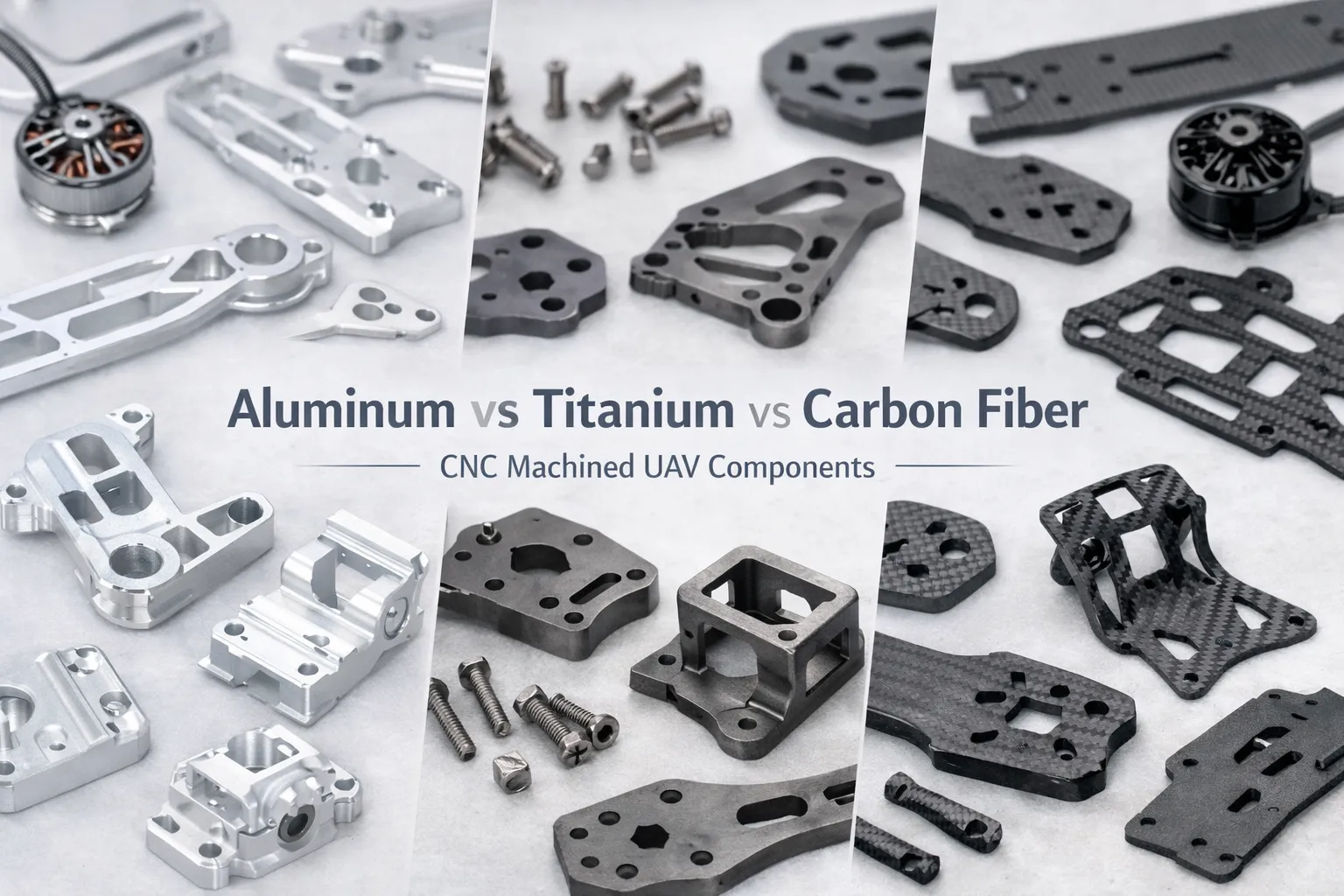
Material selection is one of the most fundamental decisions in the design and manufacturing of CNC machined UAV components. In unmanned aerial vehicles, every gram of weight, every micron of tolerance, and every variation in stiffness can directly influence flight performance, endurance, and payload capacity. Unlike general mechanical products, UAV systems operate under strict constraints where structural efficiency, vibration control, and fatigue resistance must all be optimized simultaneously.
CNC machining enables engineers to transform raw materials into highly precise aerospace-grade components, but the final performance of these parts is still fundamentally determined by the material itself. Whether the structure is made from aluminum, titanium, or carbon fiber, each material introduces different mechanical properties, machining behaviors, and cost implications. Therefore, selecting the right material is not just a manufacturing decision—it is a system-level engineering strategy.
In modern UAV development, especially in industrial inspection drones, delivery UAVs, and military-grade aerial systems, material optimization is often directly linked to mission success. A poorly chosen material may result in excessive vibration, reduced flight time, structural fatigue, or even catastrophic failure under load conditions.
For a deeper understanding of how CNC machining supports UAV system performance, you can refer to this detailed technical overview:
https://weyoungcnc.com/cnc-machining-for-drone-parts-precision-manufacturing-for-uav-components/
When selecting materials for CNC machined UAV components, engineers must evaluate multiple performance dimensions simultaneously:
UAVs must remain as lightweight as possible while maintaining structural integrity. Materials with high strength-to-weight ratios allow longer flight times and improved payload efficiency. Aluminum alloys, titanium, and carbon fiber each offer different trade-offs in this area.
UAV stability depends heavily on structural rigidity. Insufficient stiffness can lead to resonance issues, affecting onboard sensors such as cameras, LiDAR, and GPS modules. This is particularly important in precision applications where micro-vibrations can distort data accuracy.
To better understand how mechanical tolerance and structural variation affect system performance, you can explore this related technical article:
https://weyoungcnc.com/cnc-machined-robotics-parts-tolerance-stack-up-and-its-impact-on-robot-accuracy/
Different materials behave differently during CNC machining. Aluminum offers excellent machinability and fast cycle times, while titanium requires slower cutting speeds and specialized tooling. Carbon fiber, on the other hand, is typically not CNC-machined in the traditional sense but rather shaped through composite processes.
UAVs often operate in harsh environments, including high humidity, salt exposure, temperature fluctuations, and dust. Material selection must therefore account for corrosion resistance and long-term durability.
In UAV engineering, material selection is not an isolated design step—it directly influences aerodynamics, power efficiency, structural reliability, and lifecycle cost. For example, a lightweight aluminum frame may offer excellent cost efficiency for consumer drones, but may not provide sufficient stiffness for high-precision industrial UAVs. On the other hand, titanium provides exceptional strength but significantly increases cost and machining complexity.
This trade-off between performance and manufacturability is why many advanced UAV designs now adopt hybrid material structures, combining aluminum for general frames, titanium for high-stress joints, and carbon fiber for lightweight arms or aerodynamic surfaces.
Ultimately, the success of a UAV system depends on how well these materials are integrated into a cohesive engineering design. CNC machining serves as the enabling technology that transforms these material choices into functional, high-precision components.
CNC machined UAV components refer to the structural and functional parts of unmanned aerial vehicles that are manufactured using computer numerical control machining. These parts are typically produced from high-performance materials such as aluminum alloys, titanium, and engineering plastics, enabling tight tolerances, excellent repeatability, and complex geometries that are difficult to achieve through traditional manufacturing methods.
In modern UAV systems, CNC machining plays a critical role in ensuring structural reliability and flight stability. Unlike injection molding or casting, CNC machining is a subtractive process that removes material from a solid block, allowing engineers to maintain extremely precise dimensional control. This is particularly important in aerospace and drone applications, where even small deviations can impact vibration behavior, thrust alignment, or payload balance.
Typical CNC machined UAV parts include frame arms, motor mounts, gimbal brackets, landing gear components, sensor housings, and heat-dissipation structures. These components must withstand dynamic loads, vibration, and environmental stress while maintaining minimal weight. As UAV systems become more advanced—especially in industrial inspection, logistics, and defense—the demand for high-precision machining continues to increase.
For a deeper understanding of how CNC processes affect robotics and motion systems, you can refer to this technical guide on CNC machining applications in precision systems:
https://weyoungcnc.com/cnc-machining-for-robotics-processes-materials-and-design-best-practices/
CNC machined UAV components must meet several strict engineering requirements:
Most UAV structural interfaces require tolerances within ±0.01–0.05 mm to ensure correct assembly and alignment. Poor tolerance control can lead to vibration issues, motor imbalance, and reduced flight efficiency.
Weight reduction is a core design principle in UAV engineering. CNC machining allows for pocketing, ribbing, and topology-optimized structures that reduce mass without sacrificing stiffness.
One of the key advantages of CNC machining is compatibility with multiple materials, including aluminum, titanium, stainless steel, and carbon fiber composites.
Processes such as anodizing, bead blasting, and hard coating are widely used to enhance corrosion resistance and wear performance, especially for outdoor UAV applications.
Precision machining directly impacts UAV performance in areas such as aerodynamic stability, vibration control, and long-term durability. Even minor misalignment in motor mounts or frame arms can create harmonic vibration that affects sensor accuracy or flight control systems. In high-end UAVs, tolerance stack-up analysis is often used to ensure that accumulated dimensional errors remain within acceptable limits.
You can explore more about tolerance control and its impact on UAV performance in this detailed article:
https://weyoungcnc.com/cnc-machined-robotics-parts-tolerance-stack-up-and-its-impact-on-robot-accuracy/
Aluminum is the dominant material in CNC machined UAV components due to its excellent balance of strength, weight, machinability, and cost efficiency. In most commercial and industrial drones, aluminum alloys are used for structural frames, motor mounts, landing gear, and internal support structures.
Aluminum alloys such as 6061 and 7075 are particularly popular. 6061 is widely used for general-purpose structural components due to its corrosion resistance and ease of machining, while 7075 is favored in high-stress applications because of its significantly higher strength-to-weight ratio. These properties make aluminum a highly adaptable material across different UAV classes, from consumer drones to industrial inspection systems.
According to industry manufacturing data, aluminum components often account for the majority of CNC-machined parts in UAV systems due to their cost efficiency and predictable performance characteristics.
6061 is one of the most commonly used materials in drone manufacturing. It offers good mechanical strength, excellent corrosion resistance, and very high machinability, making it ideal for rapid prototyping and small-batch production.
7075 is significantly stronger than 6061 and is often used in structural UAV components that require higher load-bearing capacity. It is commonly used in motor mounts, load-bearing arms, and high-stress brackets.
Aluminum provides sufficient stiffness while maintaining low density, making it ideal for flight efficiency optimization.
CNC machining aluminum is relatively fast and cost-effective, enabling shorter lead times and lower production costs.
Aluminum can be anodized in multiple colors and finishes, improving both corrosion resistance and product aesthetics.
Aluminum efficiently dissipates heat, making it suitable for motor housings and electronic enclosures.
Industry studies consistently show that aluminum remains the most cost-effective solution for UAV structural design due to its balance of performance and manufacturability.
Despite its advantages, aluminum also has limitations. Compared to titanium or carbon fiber composites, aluminum has lower stiffness and fatigue resistance under extreme loads. In high-impact environments or military-grade UAVs, aluminum components may require reinforcement or hybrid material designs.
For a deeper look into aluminum’s role in drone manufacturing, see this technical breakdown:
https://weyoungcnc.com/cnc-machining-for-drone-parts-precision-manufacturing-for-uav-components/
Titanium is a premium material used in advanced UAV systems where maximum strength, corrosion resistance, and thermal stability are required. Unlike aluminum, titanium alloys such as Ti-6Al-4V offer extremely high tensile strength while maintaining relatively low density, making them ideal for mission-critical aerospace applications.
Titanium is commonly used in UAV components such as high-load motor mounts, structural connectors, landing gear assemblies, and vibration-resistant brackets. In military and industrial UAV systems, titanium is often selected when structural failure is not an option.
This is the most widely used titanium alloy in aerospace applications. It offers an excellent combination of strength, corrosion resistance, and fatigue performance, making it suitable for long-term structural use in UAV systems.
Although softer than Grade 5, Grade 2 titanium provides excellent corrosion resistance and is sometimes used in non-critical UAV components requiring environmental durability.
Titanium is nearly twice as strong as aluminum at similar weight levels, making it ideal for high-load UAV structures.
Titanium performs extremely well under repeated stress cycles, making it suitable for long-endurance UAV missions.
Titanium is highly resistant to moisture, salt, and chemical exposure, making it ideal for marine and harsh-environment UAV applications.
Titanium maintains its mechanical properties under high temperatures, which is important for high-performance UAV propulsion systems.
While titanium offers excellent performance, it is significantly more difficult to machine than aluminum. Its low thermal conductivity causes heat buildup during cutting, which increases tool wear and machining time. As a result, titanium CNC parts are more expensive and require specialized tooling and slower machining speeds.
This makes titanium best suited for high-value UAV applications where performance outweighs cost considerations.
Carbon fiber has become one of the most important materials in UAV structural engineering due to its exceptional combination of ultra-lightweight properties and extremely high stiffness. Unlike metals such as aluminum or titanium, carbon fiber is a composite material made from carbon filaments embedded in a polymer matrix. This structure allows it to achieve very high directional strength while maintaining extremely low density, making it ideal for applications where weight reduction is the top priority.
In UAV systems, carbon fiber is most commonly used in structural arms, frame plates, propeller supports, and aerodynamic shells. These components benefit from carbon fiber’s ability to reduce overall system weight while maintaining rigidity under flight loads. The result is improved flight efficiency, longer endurance, and better maneuverability.
However, it is important to note that carbon fiber is not typically CNC machined in the same way as metals. Instead, it is usually manufactured through molding, layering, and curing processes, followed by limited CNC trimming or drilling. This makes it fundamentally different from aluminum or titanium components, which are fully CNC-machinable.
Carbon fiber offers one of the best strength-to-weight ratios among engineering materials, making it ideal for high-performance drones that require maximum efficiency.
Its rigidity helps reduce frame flexing during flight, which improves sensor stability and overall aerodynamic control.
Carbon fiber naturally absorbs vibrations better than metals, which is critical for UAVs carrying cameras, LiDAR, or precision instruments.
Despite its advantages, carbon fiber has several limitations. It is relatively brittle compared to metals, meaning it can crack under sudden impact rather than deforming. It is also more difficult to repair and has higher manufacturing complexity. Additionally, its anisotropic properties mean strength varies depending on fiber direction, requiring careful engineering design.
For UAV designers combining carbon fiber with CNC-machined metal structures, it is important to ensure proper interface design and load distribution. More insights into precision UAV manufacturing can be found here:
https://weyoungcnc.com/cnc-machining-for-drone-parts-precision-manufacturing-for-uav-components/
Carbon fiber is the lightest among the three materials, followed by aluminum, while titanium is the heaviest. However, titanium compensates with superior strength, meaning less material may be needed in structural design.
Titanium performs best under extreme mechanical stress and impact conditions. Aluminum performs well under normal UAV operating loads but may deform under high stress. Carbon fiber excels in rigidity but is more vulnerable to sudden impact damage.
Each material serves a different engineering purpose:
For consumer drones, cost efficiency and lightweight design are the top priorities. Aluminum is commonly used for frames and mounts, while carbon fiber is used for arms and propeller structures. This hybrid approach provides a good balance between performance and affordability.
Industrial drones used for inspection, mapping, and surveying require higher durability and stability. In these systems, 7075 aluminum is often used for structural components, while carbon fiber is used for vibration-sensitive areas. Titanium may be introduced in high-stress joints.
Military-grade UAVs prioritize performance, durability, and mission reliability over cost. These systems often use titanium for critical load-bearing structures and carbon fiber for ultra-light aerodynamic components. This combination ensures maximum endurance and survivability in extreme environments.
Modern UAV design increasingly adopts hybrid material structures. Instead of relying on a single material, engineers strategically combine aluminum, titanium, and carbon fiber to optimize performance across different structural zones. This approach allows UAVs to achieve better flight efficiency while maintaining structural integrity.
One of the most important design considerations in CNC machined UAV parts is weight reduction. Engineers use techniques such as pocketing, rib reinforcement, and topology optimization to reduce unnecessary material while maintaining structural strength. Every gram saved contributes directly to longer flight time and improved payload capacity.
Precision is critical in UAV systems. Tight tolerances ensure proper alignment between motor mounts, frame arms, and electronic housings. Poor tolerance control can lead to vibration, inefficiency, or even system failure.
To understand how tolerance variation impacts UAV performance, you can refer to this technical resource:
https://weyoungcnc.com/cnc-machined-robotics-parts-tolerance-stack-up-and-its-impact-on-robot-accuracy/
UAVs operate under continuous vibration during flight. CNC-machined parts must be designed to minimize resonance effects. Material selection, geometry optimization, and proper assembly design all play key roles in reducing fatigue-related failures over time.
Heat dissipation is another important factor, especially in high-performance UAVs with powerful motors and onboard electronics. Aluminum is often preferred for heat sinks and motor housings due to its excellent thermal conductivity.
Designing UAV parts for CNC machining requires consideration of tool access, machining time, and cost efficiency. Overly complex geometries may increase machining difficulty and lead to higher production costs. Therefore, engineers must balance design complexity with manufacturability.
For more insights into CNC optimization in robotics and UAV systems, you can refer to this guide:
https://weyoungcnc.com/cnc-machining-for-robotics-processes-materials-and-design-best-practices/
Carbon fiber has become one of the most important materials in UAV structural engineering due to its exceptional combination of ultra-lightweight properties and extremely high stiffness. Unlike metals such as aluminum or titanium, carbon fiber is a composite material made from carbon filaments embedded in a polymer matrix. This structure allows it to achieve very high directional strength while maintaining extremely low density, making it ideal for applications where weight reduction is the top priority.
In UAV systems, carbon fiber is most commonly used in structural arms, frame plates, propeller supports, and aerodynamic shells. These components benefit from carbon fiber’s ability to reduce overall system weight while maintaining rigidity under flight loads. The result is improved flight efficiency, longer endurance, and better maneuverability.
However, it is important to note that carbon fiber is not typically CNC machined in the same way as metals. Instead, it is usually manufactured through molding, layering, and curing processes, followed by limited CNC trimming or drilling. This makes it fundamentally different from aluminum or titanium components, which are fully CNC-machinable.
Carbon fiber offers one of the best strength-to-weight ratios among engineering materials, making it ideal for high-performance drones that require maximum efficiency.
Its rigidity helps reduce frame flexing during flight, which improves sensor stability and overall aerodynamic control.
Carbon fiber naturally absorbs vibrations better than metals, which is critical for UAVs carrying cameras, LiDAR, or precision instruments.
Despite its advantages, carbon fiber has several limitations. It is relatively brittle compared to metals, meaning it can crack under sudden impact rather than deforming. It is also more difficult to repair and has higher manufacturing complexity. Additionally, its anisotropic properties mean strength varies depending on fiber direction, requiring careful engineering design.
For UAV designers combining carbon fiber with CNC-machined metal structures, it is important to ensure proper interface design and load distribution. More insights into precision UAV manufacturing can be found here:
https://weyoungcnc.com/cnc-machining-for-drone-parts-precision-manufacturing-for-uav-components/
Carbon fiber is the lightest among the three materials, followed by aluminum, while titanium is the heaviest. However, titanium compensates with superior strength, meaning less material may be needed in structural design.
Titanium performs best under extreme mechanical stress and impact conditions. Aluminum performs well under normal UAV operating loads but may deform under high stress. Carbon fiber excels in rigidity but is more vulnerable to sudden impact damage.
Each material serves a different engineering purpose:
For consumer drones, cost efficiency and lightweight design are the top priorities. Aluminum is commonly used for frames and mounts, while carbon fiber is used for arms and propeller structures. This hybrid approach provides a good balance between performance and affordability.
Industrial drones used for inspection, mapping, and surveying require higher durability and stability. In these systems, 7075 aluminum is often used for structural components, while carbon fiber is used for vibration-sensitive areas. Titanium may be introduced in high-stress joints.
Military-grade UAVs prioritize performance, durability, and mission reliability over cost. These systems often use titanium for critical load-bearing structures and carbon fiber for ultra-light aerodynamic components. This combination ensures maximum endurance and survivability in extreme environments.
Modern UAV design increasingly adopts hybrid material structures. Instead of relying on a single material, engineers strategically combine aluminum, titanium, and carbon fiber to optimize performance across different structural zones. This approach allows UAVs to achieve better flight efficiency while maintaining structural integrity.
One of the most important design considerations in CNC machined UAV parts is weight reduction. Engineers use techniques such as pocketing, rib reinforcement, and topology optimization to reduce unnecessary material while maintaining structural strength. Every gram saved contributes directly to longer flight time and improved payload capacity.
Precision is critical in UAV systems. Tight tolerances ensure proper alignment between motor mounts, frame arms, and electronic housings. Poor tolerance control can lead to vibration, inefficiency, or even system failure.
To understand how tolerance variation impacts UAV performance, you can refer to this technical resource:
https://weyoungcnc.com/cnc-machined-robotics-parts-tolerance-stack-up-and-its-impact-on-robot-accuracy/
UAVs operate under continuous vibration during flight. CNC-machined parts must be designed to minimize resonance effects. Material selection, geometry optimization, and proper assembly design all play key roles in reducing fatigue-related failures over time.
Heat dissipation is another important factor, especially in high-performance UAVs with powerful motors and onboard electronics. Aluminum is often preferred for heat sinks and motor housings due to its excellent thermal conductivity.
Designing UAV parts for CNC machining requires consideration of tool access, machining time, and cost efficiency. Overly complex geometries may increase machining difficulty and lead to higher production costs. Therefore, engineers must balance design complexity with manufacturability.
For more insights into CNC optimization in robotics and UAV systems, you can refer to this guide:
https://weyoungcnc.com/cnc-machining-for-robotics-processes-materials-and-design-best-practices/
