Address
304 North Cardinal St.
Dorchester Center, MA 02124
Work Hours
Monday to Friday: 7AM - 7PM
Weekend: 10AM - 5PM

Address
304 North Cardinal St.
Dorchester Center, MA 02124
Work Hours
Monday to Friday: 7AM - 7PM
Weekend: 10AM - 5PM

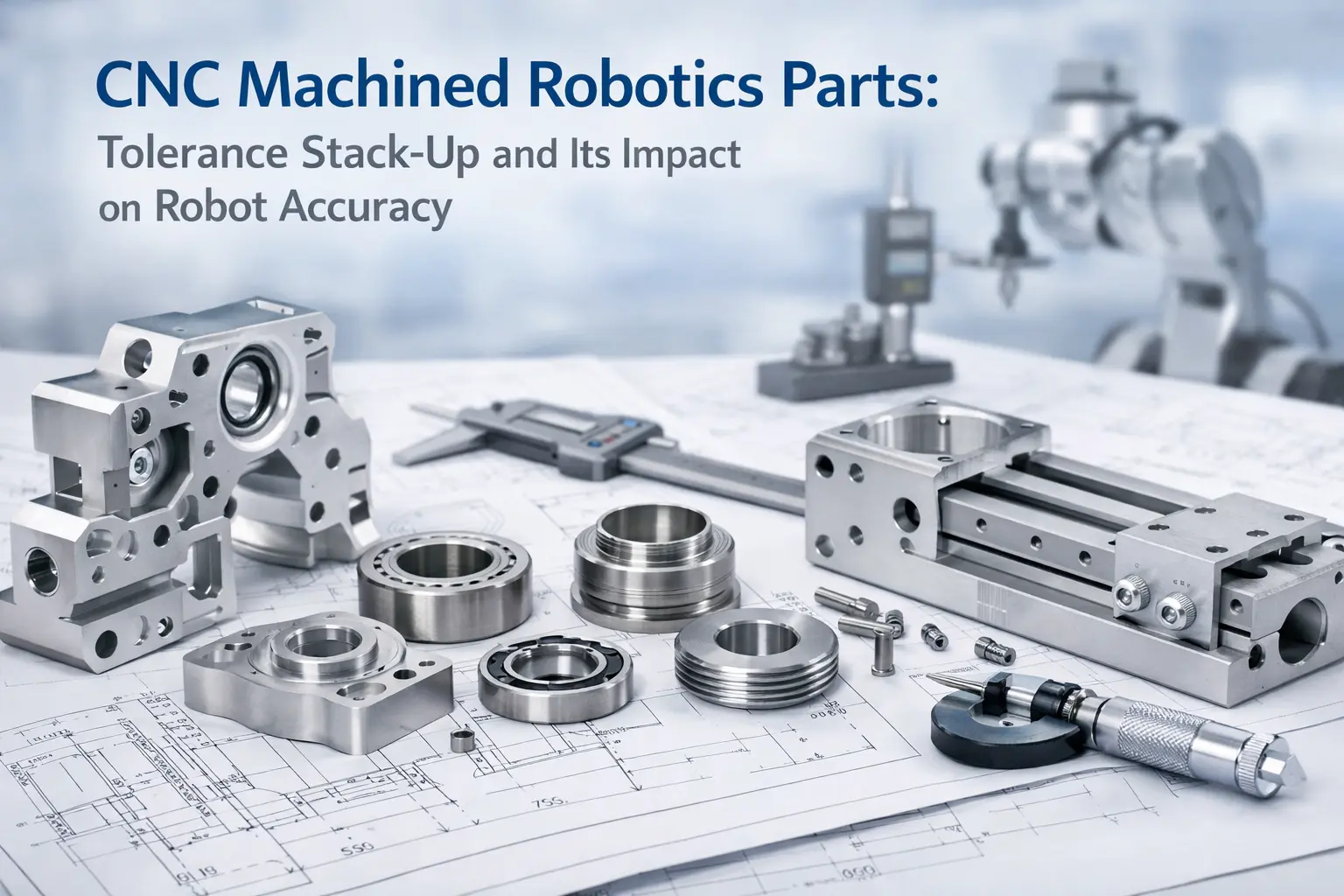
In modern robotics engineering, precision is not just a quality requirement—it is the foundation of system performance. CNC machined robotics parts form the structural and functional backbone of robotic systems, including robotic arms, end effectors, joints, housings, and motion control components. Unlike general mechanical products, robotic systems operate in highly coordinated multi-axis motion environments, where even micron-level deviations can significantly affect final output accuracy, speed, and repeatability.
In CNC manufacturing for robotics, every component must align perfectly within a larger assembly system. This is why tolerance control becomes critical. A robotic arm, for example, is not a single part but a chain of interconnected joints and links. Each interface introduces a small dimensional variation, and when these variations accumulate, they directly influence the robot’s positional accuracy.
This topic is closely related to advanced manufacturing processes such as high-precision milling, turning, and multi-axis machining. If you want a deeper understanding of how different machining methods contribute to robotics component quality, you can explore this detailed guide on CNC machining for robotics applications:
https://weyoungcnc.com/cnc-machining-for-robotics-processes-materials-and-design-best-practices/
Tolerance in CNC machining refers to the acceptable deviation from a nominal dimension. In robotics applications, tolerances are typically much tighter than in general industrial parts because robots require consistent motion accuracy and repeatable positioning. For example, a deviation of 0.05 mm might be acceptable in general machinery, but in precision robotic assemblies, this small deviation can lead to noticeable end-effector misalignment.
The importance of tolerance becomes even more significant in dynamic systems where motion is continuous. Each moving joint amplifies small errors from previous components. Over time, these errors do not cancel out—they accumulate. This is where the concept of tolerance stack-up becomes critical, which we will discuss in the next section.
From a manufacturing perspective, achieving tight tolerances depends on multiple factors, including CNC machine rigidity, tool condition, material selection, and machining strategy. Processes like CNC turning and CNC milling contribute differently to dimensional stability. For example, turning operations are typically used for cylindrical symmetry parts, while milling is used for complex geometries and multi-surface components. You can compare both processes in detail here:
https://weyoungcnc.com/cnc-turning-vs-milling-complete-comparison-and-practical-guide/
Industries such as industrial automation, aerospace robotics, and medical robotics require extremely high levels of dimensional consistency. In these fields, CNC machined parts are not just structural elements—they directly determine system intelligence and motion control reliability. A small deviation in a mounting bracket or gear housing can lead to vibration, energy loss, or even system failure.
This is why manufacturers like WeYoung CNC focus heavily on precision engineering, process control, and inspection systems to ensure that every robotic component meets strict tolerance requirements before assembly. In robotics manufacturing, precision is not optional—it is the key to competitive performance.
Tolerance in CNC machining refers to the permissible variation in a part’s dimensions during manufacturing. No machining process can produce a perfectly exact dimension; instead, each feature is produced within a defined tolerance range. For example, a shaft specified as 20.00 mm ±0.02 mm means its actual diameter can range from 19.98 mm to 20.02 mm and still be considered acceptable.
In isolation, this deviation seems insignificant. However, when multiple parts are assembled together in a mechanical system—especially in robotics—the combined effect of these small deviations becomes much more important. This is where tolerance stack-up begins to play a critical role.
Tolerance stack-up refers to the cumulative effect of individual part tolerances in an assembly. When multiple components are assembled in a sequence—such as links in a robotic arm—each part contributes its own dimensional variation. These variations add up, leading to a final positional deviation that can be significantly larger than any single component’s tolerance.
For example, consider a robotic arm with five connected segments. If each segment has a small angular or linear deviation within allowable tolerance, the final end-effector position may deviate noticeably from its intended position. This accumulated error is what engineers refer to as tolerance stack-up.
This concept is especially important in CNC machining because robotics systems rely on multi-part assemblies. Even if each part is manufactured within specification, the overall system performance may still suffer if stack-up is not properly controlled during design and machining stages.
There are generally two major types of tolerance accumulation in CNC machined assemblies:
Linear Stack-Up:
This occurs when dimensional tolerances accumulate along a straight assembly path, such as stacked spacers, housings, or linear guide systems. Each small deviation adds directly to the total length error.
Geometric Stack-Up:
This occurs when angular, positional, or rotational tolerances accumulate, especially in rotating or articulated systems like robotic arms. In these cases, small angular deviations can lead to large positional errors at the end effector.
Understanding both types is essential for designing robotic systems that maintain accuracy under real-world operating conditions.
CNC machining is one of the most reliable manufacturing methods for controlling tolerance stack-up because it offers high repeatability and process consistency. However, machining alone is not enough. The real control comes from combining precision manufacturing with smart design practices such as GD&T (Geometric Dimensioning and Tolerancing), datum-based alignment, and reduced part count strategies.
Different machining processes also influence stack-up behavior differently. For instance, milling operations are often used for complex multi-surface components, while turning is ideal for high-precision cylindrical parts. Understanding these differences helps engineers choose the right process for minimizing cumulative error. A detailed comparison of these processes can be found here:
https://weyoungcnc.com/plain-milling-explained-process-types-benefits-and-industrial-applications/
One of the most direct consequences of tolerance stack-up in CNC machined robotics parts is the loss of positional accuracy. Robots are designed to execute highly controlled movements based on programmed coordinates. However, when mechanical deviations exist in joints, brackets, and linkages, the actual position of the end effector may differ from the intended position.
Even extremely small deviations at each joint can accumulate across multiple axes of motion. For example, a 0.01 mm deviation in several connected joints can result in a noticeable multi-millimeter error at the tool tip. This is especially critical in applications such as pick-and-place automation, laser cutting, and precision assembly, where positional accuracy directly affects product quality.
In robotics, repeatability is often more important than absolute accuracy. A robot may consistently reach the same incorrect position if tolerance stack-up is present. While this may sound stable, it creates serious issues in manufacturing environments where components must align perfectly.
When stack-up errors exist, robots may show inconsistent behavior when interacting with fixtures or other machines. Over time, this leads to increased calibration requirements, higher maintenance costs, and reduced system efficiency. In high-volume production environments, even small inconsistencies can lead to significant quality control challenges.
Tolerance stack-up does not only affect positioning—it also impacts mechanical stress distribution. When parts are not perfectly aligned due to accumulated errors, uneven force distribution occurs across joints and interfaces. This leads to accelerated wear, increased vibration, and reduced system lifespan.
In CNC machined robotics assemblies, misalignment between mating surfaces can cause frictional resistance, which further amplifies mechanical degradation. Over time, this results in loosened connections, reduced stiffness, and lower overall system stability.
Controlling tolerance stack-up is essential to ensure long-term stability, accuracy, and efficiency in robotic systems. This requires a combination of precision CNC machining, optimized design strategies, and strict quality inspection. By reducing the number of parts, improving datum alignment, and selecting appropriate machining processes, engineers can significantly reduce cumulative error.
Ultimately, robot accuracy is not defined by a single component but by the entire manufacturing and assembly system. Effective control of tolerance stack-up ensures that CNC machined robotics parts perform reliably under real-world operating conditions, maintaining both precision and durability over time.
In CNC machined robotics parts, achieving tight tolerance is not determined by a single factor but by a combination of machine capability, process stability, material behavior, and environmental control. Robotics components require extremely consistent dimensional accuracy because even small variations can affect motion alignment, load distribution, and system repeatability.
Unlike general machining, robotics parts often involve multi-axis movement structures such as robotic arms, joint housings, and precision mounts. These components require not only dimensional accuracy but also geometric consistency across multiple surfaces. Therefore, understanding the key CNC machining factors that influence tolerance is essential for engineering high-performance robotic systems.
The first and most important factor affecting tolerance is the CNC machine itself. High-precision robotics components typically require advanced 5-axis CNC machines rather than basic 3-axis systems. The reason is simple: fewer setups mean fewer alignment errors.
Machine rigidity also plays a critical role. If a CNC machine lacks structural stiffness, vibration during cutting can introduce micro-deviations in surface geometry. These deviations may seem negligible in isolation but can accumulate significantly in robotic assemblies.
For robotics applications, multi-axis machining is especially important because it allows complex geometries to be completed in a single setup. This reduces fixture changes and eliminates cumulative positioning errors. You can explore more about different machining approaches in this detailed comparison:
https://weyoungcnc.com/cnc-turning-vs-milling-complete-comparison-and-practical-guide/
Material selection has a direct impact on tolerance stability. Different materials respond differently to cutting forces, heat generation, and environmental conditions.
For example:
During CNC machining, heat generated by cutting tools can cause temporary or permanent dimensional changes. When the part cools down, it may contract slightly, affecting final tolerance.
This is particularly important in robotics, where parts must maintain dimensional stability under dynamic load conditions. Material behavior must therefore be considered during both design and machining stages.
Tool wear is another critical factor affecting machining tolerance. As cutting tools degrade, dimensional accuracy gradually shifts, especially in long production runs. In robotics manufacturing, this can lead to inconsistent batch quality if not properly controlled.
Cutting speed, feed rate, and depth of cut also influence tolerance. Aggressive machining parameters may increase productivity but reduce precision due to vibration and heat generation. Therefore, a balance between efficiency and stability is required.
Advanced CNC manufacturers use real-time monitoring and tool compensation systems to maintain consistent accuracy across production cycles.
Environmental conditions such as temperature and humidity can also affect machining precision. Even small temperature changes in a workshop can cause expansion or contraction in both machine structures and workpieces.
High-end CNC production environments for robotics parts often maintain controlled temperatures to minimize these effects. This ensures that dimensional tolerances remain stable throughout the machining process and inspection stages.
While CNC machining capability is important, tolerance stack-up control begins at the design stage. In robotics systems, poor design decisions can amplify small machining variations into major assembly errors. Therefore, engineers must design parts in a way that minimizes cumulative error from the beginning.
Reducing tolerance stack-up is not just about tightening tolerances—it is about designing smarter assemblies that naturally resist error accumulation.
One of the most effective strategies for controlling tolerance stack-up is the use of GD&T (Geometric Dimensioning and Tolerancing). Unlike simple ± dimensional tolerances, GD&T defines functional relationships between features, ensuring that parts fit and function correctly even when minor variations exist.
For robotics components, GD&T ensures:
By defining functional tolerances instead of arbitrary dimensional limits, engineers can significantly reduce unnecessary precision costs while maintaining performance.
One of the most practical ways to reduce tolerance stack-up is to reduce the number of individual parts in an assembly. Every additional component introduces another source of dimensional variation.
For example, combining multiple brackets into a single CNC machined structure can eliminate multiple alignment interfaces. This directly reduces accumulated error and improves system rigidity.
This strategy is widely used in high-performance robotics, aerospace systems, and automation equipment where precision is critical.
Datum-based design ensures that all critical features reference a consistent baseline. This approach is essential in robotics because it guarantees predictable alignment between components.
Instead of allowing each part to define its own reference point, datum-based design ensures that all tolerances accumulate relative to a controlled coordinate system. This significantly reduces geometric stack-up errors in multi-axis assemblies.
Not all features in a robotic system require ultra-tight tolerances. Over-tolerancing increases manufacturing cost without improving performance. Engineers must strategically assign tolerance levels based on functional requirements.
Critical motion components require tight tolerances, while non-functional structural parts can use looser specifications. This balanced approach reduces cost while maintaining performance.
Even with optimized design and material selection, CNC machining process control ultimately determines final part quality. In robotics manufacturing, process optimization ensures that every component is produced consistently within required tolerance limits.
Process optimization is especially important in high-precision industries because even small variations between production batches can affect robotic system calibration and performance.
CNC milling is one of the most widely used processes for robotics parts due to its flexibility in producing complex geometries. However, achieving tight tolerances requires optimized tool paths, stable cutting parameters, and minimal vibration.
Advanced milling strategies include:
If you want to explore milling fundamentals in detail, you can refer to this guide:
https://weyoungcnc.com/plain-milling-explained-process-types-benefits-and-industrial-applications/
One of the most effective ways to reduce tolerance stack-up in manufacturing is to minimize the number of setups required during machining. Every repositioning introduces potential alignment error.
5-axis CNC machining allows multiple surfaces to be processed in a single setup, significantly improving geometric consistency. This is particularly important for robotics components with complex spatial structures such as joint housings and actuator mounts.
By reducing fixture changes, manufacturers can ensure better repeatability and tighter overall tolerance control.
Modern CNC machining for robotics parts often integrates in-process inspection systems. These systems measure critical dimensions during production rather than after completion, allowing immediate corrections if deviations occur.
Closed-loop feedback systems adjust tool paths automatically based on measurement data, ensuring consistent accuracy across production runs.
This approach is especially important for high-volume robotics manufacturing where consistency is as important as precision.
After machining, components are typically verified using Coordinate Measuring Machines (CMM). These devices provide highly accurate dimensional measurements to ensure that parts meet design specifications.
CMM inspection is essential in robotics manufacturing because it validates both individual part accuracy and batch consistency. Without this step, tolerance stack-up issues may only become visible during final assembly, leading to costly rework.
CNC machining process optimization ensures that design intent is accurately translated into physical components. By combining advanced machining strategies, multi-axis capabilities, and rigorous inspection systems, manufacturers can significantly reduce tolerance stack-up and improve robot performance.
In high-end robotics applications, precision is not achieved by chance—it is the result of tightly controlled engineering and manufacturing systems working together seamlessly.
CNC machined robotics parts are widely used across industries where precision, repeatability, and reliability are critical. In real-world robotics applications, tolerance stack-up is not just a theoretical design concern—it directly determines whether a robotic system can function correctly under operational conditions.
Robotic systems are composed of multiple interconnected mechanical components, including structural frames, joint assemblies, actuator housings, gear systems, and end-effectors. Each of these components must maintain tight dimensional and geometric consistency. Even small deviations in CNC machined parts can accumulate through the mechanical chain, affecting positioning accuracy, motion smoothness, and load distribution.
This is why industries that depend on robotics technology invest heavily in precision CNC manufacturing and strict tolerance control strategies.
One of the most common applications of CNC machined robotics parts is industrial robotic arms used in manufacturing automation. These systems perform tasks such as welding, assembly, material handling, and packaging.
In robotic arms, tolerance stack-up directly affects end-effector positioning accuracy. Since robotic arms typically consist of multiple rotating joints and linkages, each joint introduces a small angular and linear deviation. When combined, these deviations can significantly shift the final tool position.
To maintain accuracy, manufacturers rely on high-precision CNC machined components with carefully controlled tolerances and rigid assembly structures.
Medical robotics represents one of the most demanding fields for CNC machined components. Surgical robots require extremely high precision because they operate in sensitive environments where even sub-millimeter deviations matter.
In these systems, tolerance stack-up must be minimized to ensure safe and accurate instrument positioning. CNC machined titanium and stainless steel components are commonly used due to their stability and biocompatibility.
Any accumulated error in joint alignment or tool positioning could directly impact surgical outcomes, making tolerance control a critical engineering requirement rather than an optional optimization.
In aerospace robotics, CNC machined components are used in satellite positioning systems, unmanned aerial vehicles (UAVs), and automated inspection systems. These environments require components that can withstand extreme conditions while maintaining dimensional stability.
Tolerance stack-up in aerospace applications can lead to navigation errors, structural misalignment, or system instability. Therefore, multi-axis CNC machining and advanced inspection methods are widely used to ensure consistency across all components.
Material selection and thermal stability are also especially important due to rapid temperature changes in aerospace environments.
In smart factories and automated production lines, robotics systems are used for continuous, high-speed operations. These systems rely on precise coordination between multiple robotic units.
If tolerance stack-up occurs in CNC machined components, it can lead to misalignment between robots, causing production inefficiencies or product defects. For this reason, manufacturers prioritize standardized CNC machining processes and strict quality control systems to ensure consistency across large production volumes.
At the manufacturing level, controlling tolerance stack-up requires a combination of advanced CNC technology, process discipline, engineering support, and inspection systems. It is not a single step but a complete production strategy that ensures dimensional accuracy from raw material to final inspection.
At WeYoung CNC, precision control is embedded throughout the entire production workflow, from design review to final quality assurance, ensuring that every robotics component meets strict functional requirements.
You can learn more about our CNC machining capabilities for robotics applications here:
https://weyoungcnc.com/cnc-machining-for-robotics-processes-materials-and-design-best-practices/
One of the key methods used to control tolerance stack-up is strict process standardization. Each machining operation is carefully planned to minimize variability between parts and production batches.
This includes:
By eliminating uncontrolled variables, manufacturers can significantly reduce dimensional deviations across multi-part assemblies.
Multi-axis CNC machining plays a critical role in minimizing tolerance accumulation. By machining complex geometries in a single setup, manufacturers eliminate multiple repositioning steps that could introduce alignment errors.
This is especially important for robotics components such as:
Reducing setup count directly improves geometric consistency and ensures better alignment between functional surfaces.
Another key control strategy is early-stage engineering involvement. Design for Manufacturability (DFM) ensures that parts are optimized for CNC machining before production begins.
This includes:
By aligning design intent with manufacturing capability, engineers can prevent tolerance issues before they occur.
Quality inspection is the final and most critical stage of tolerance control. Advanced measurement systems such as CMM (Coordinate Measuring Machines) are used to verify every critical dimension.
Inspection ensures:
This closed-loop quality system ensures that tolerance stack-up does not enter the final robotic system.
In CNC machined robotics systems, tolerance control is not just a manufacturing detail—it is the foundation of overall system performance. Every robotic system is only as accurate as its weakest dimensional link. When multiple CNC machined components are assembled together, even the smallest deviations can accumulate into significant positional errors.
Tolerance stack-up affects every critical aspect of robotics performance, including positioning accuracy, repeatability, mechanical stability, and long-term reliability. Without proper control, even highly advanced robotic systems may fail to achieve their intended precision levels.
One of the most important insights in robotics manufacturing is that accuracy is a system-level property, not a single-part characteristic. A perfectly machined component can still contribute to system inaccuracy if it interacts with poorly controlled mating parts.
This is why modern CNC manufacturing focuses not only on individual part precision but also on assembly-level tolerance strategy. Techniques such as GD&T, datum-based design, and multi-axis machining all contribute to reducing cumulative error across the entire system.
For a deeper understanding of machining methods that support precision manufacturing, you can also explore this comparison between milling and turning processes:
https://weyoungcnc.com/cnc-turning-vs-milling-complete-comparison-and-practical-guide/
In today’s robotics industry, precision is a competitive advantage. Companies that can control tolerance stack-up effectively can build more accurate, reliable, and durable robotic systems.
Through advanced CNC machining processes, optimized design strategies, and strict quality control systems, manufacturers can significantly reduce cumulative error and improve overall system performance.
Ultimately, controlling tolerance stack-up is not just about meeting specifications—it is about enabling robotics systems to perform with consistency, efficiency, and long-term reliability in real-world applications.
