Address
304 North Cardinal St.
Dorchester Center, MA 02124
Work Hours
Monday to Friday: 7AM - 7PM
Weekend: 10AM - 5PM

Address
304 North Cardinal St.
Dorchester Center, MA 02124
Work Hours
Monday to Friday: 7AM - 7PM
Weekend: 10AM - 5PM

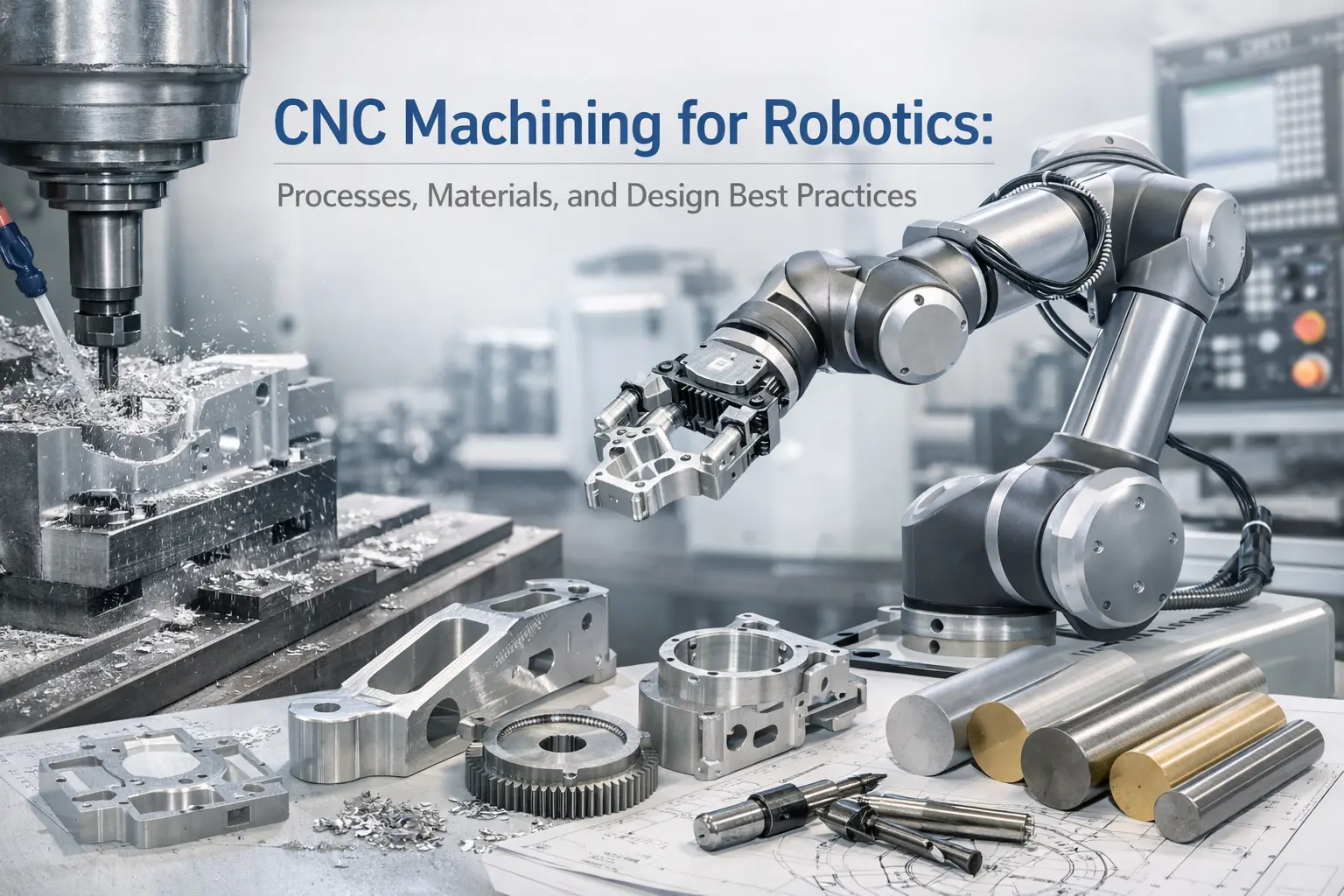
Robotics manufacturing is entering a new era where precision, speed, and customization are more important than ever. From industrial automation systems to AI-driven robotic platforms, every movement depends on highly accurate mechanical components.
Among all manufacturing technologies, CNC machining for robotics has become the most reliable solution for producing complex, high-precision parts with consistent quality and fast turnaround times.
Unlike traditional manufacturing methods, CNC machining allows engineers to directly convert CAD designs into functional parts with micron-level accuracy. This makes it ideal for robotics applications where even the smallest deviation can affect system performance, stability, and efficiency.
CNC machining for robotics refers to the process of using computer-controlled machining systems to manufacture robotic components with high precision, repeatability, and mechanical strength.
These components typically include:
By following digital instructions from CAD/CAM files, CNC machines can produce parts with extremely tight tolerances, making them suitable for both prototype development and mass production in robotics engineering.
In modern robotics development, CNC machining is not just a manufacturing method—it is a critical bridge between design engineering and functional hardware implementation.
CNC machining offers several advantages that make it essential in robotics production:
Robotics systems require extremely tight tolerances, often within ±0.01mm or better. CNC machining ensures every part meets exact specifications, reducing assembly errors and improving motion stability.
Whether producing 1 prototype or 1,000 production units, CNC machining ensures every robotic component remains identical in geometry and performance.
CNC machining supports a wide range of engineering materials, including aluminum, stainless steel, titanium, brass, and high-performance plastics.
Robotics development cycles are fast. CNC machining allows engineers to quickly modify designs and produce updated parts without tooling delays.
Unlike 3D printing, CNC-machined parts retain the original structural integrity of the material, making them suitable for load-bearing robotic systems.
CNC machining is widely used across different robotics industries:
These applications require a combination of strength, precision, and lightweight optimization, all of which CNC machining can deliver effectively.
Robotics systems rely heavily on mechanical accuracy. Even minor machining errors can lead to vibration, misalignment, or system failure.
Modern robotics assemblies include multiple moving parts such as:
Each of these requires extremely precise machining to ensure smooth operation and long-term durability.
CNC machining ensures:
This level of precision is difficult to achieve with conventional manufacturing methods.
Compared to casting or additive manufacturing, CNC-machined robotic parts offer significantly higher structural reliability.
Key advantages include:
This makes CNC machining especially suitable for industrial robotics systems operating 24/7 in high-load environments.
Robotics development is highly iterative. Engineers frequently update designs based on performance testing and system optimization.
CNC machining supports this workflow by enabling:
This significantly shortens product development cycles and improves engineering efficiency.
Different robotic components require different machining processes depending on geometry, function, and load requirements.
CNC milling is one of the most commonly used processes in robotics manufacturing.
It is ideal for producing:
Milling machines use rotating cutting tools to remove material from solid blocks, allowing for highly complex 3D geometries.
For engineers comparing manufacturing strategies, milling is often preferred for multi-surface robotic structures requiring high dimensional stability.
CNC turning is used for producing rotational parts that require high symmetry and smooth surface finish.
Common robotics components include:
Turning ensures excellent concentricity, which is critical for reducing mechanical vibration in robotic motion systems.
👉 For a deeper comparison of machining processes, you can refer to this guide:
https://weyoungcnc.com/cnc-turning-vs-milling-complete-comparison-and-practical-guide/
5-axis CNC machining is essential for producing highly complex robotic parts with curved surfaces and multi-angle geometries.
It enables:
This process is widely used in robot joints, aerospace robotics, and high-end automation systems where precision is critical.
Material selection plays a crucial role in robotics performance. The wrong material can lead to excessive weight, mechanical failure, or reduced system efficiency.
Aluminum is the most widely used material in robotics due to its excellent balance of:
It is commonly used in robotic arms and structural frames.
Stainless steel is preferred for applications requiring:
Titanium is used in high-end robotics systems where:
Common plastics include:
These materials are often used for:
When selecting materials for robotics CNC machining, engineers must consider:
Poor material selection can lead to early system failure or reduced efficiency.
👉 A common mistake in material selection is overlooking machining limitations and stress points. You can see related design issues here:
https://weyoungcnc.com/design-tips-for-machining-brass-parts-avoiding-common-mistakes/
Design for Manufacturability (DFM) is one of the most critical factors in CNC machining for robotics components. Even the most advanced robotic system can fail if the parts are not designed with machining limitations and assembly requirements in mind.
DFM focuses on optimizing part geometry to ensure:
In robotics manufacturing, engineers should avoid overly complex internal structures that require multiple setups or special tooling. Instead, designs should prioritize machinability and functional efficiency.
Common DFM optimization strategies include:
Robotics systems rely heavily on precision alignment. However, not all dimensions require ultra-tight tolerances.
A smart tolerance strategy includes:
Over-tolerancing is one of the most common mistakes in robotics machining, leading to unnecessary cost increases without performance improvement.
Weight reduction plays a major role in robotics performance, especially in:
CNC machining allows engineers to reduce weight through:
A well-optimized lightweight design improves:
CNC machining plays a foundational role across nearly every robotics sector. Its ability to produce high-precision, durable, and repeatable components makes it indispensable for modern automation systems.
Industrial robots operate in high-load and high-cycle environments. CNC machining is widely used for:
These systems require both strength and precision to maintain 24/7 production stability.
Medical robotics demands extremely high precision and reliability. CNC machining is used for:
These components must meet strict regulatory and safety standards, where even micron-level errors matter.
In smart factories, CNC-machined robotic parts are used in:
The combination of precision and repeatability ensures stable automation performance.
In aerospace robotics, CNC machining is used for:
These applications require extreme:
Choosing the right manufacturing method is critical in robotics development. Each process has strengths and limitations depending on the application stage.
3D printing is often used for early-stage prototypes, but CNC machining is superior in functional robotics parts.
| Factor | CNC Machining | 3D Printing |
|---|---|---|
| Precision | High (±0.01mm) | Medium |
| Strength | Excellent | Limited |
| Surface Finish | Smooth | Rough |
| Production Use | Yes | Limited |
| Material Range | Wide | Limited |
👉 CNC machining is preferred for functional robotics components and production-ready parts.
Injection molding is cost-effective for high-volume production, but less flexible for robotics development.
Key differences:
Despite its advantages, CNC machining for robotics also presents several engineering challenges.
Some robotic parts include deep cavities or undercuts that are difficult to machine.
Solution:
Ultra-precision machining significantly increases cost.
Solution:
Thin-walled robotic parts may deform during machining.
Solution:
Robotics parts often require smooth finishes for motion efficiency.
Solution:
Cost is a major concern in robotics development, especially for startups and R&D teams.
Engineers can reduce cost by:
Proper design decisions can reduce cost by 20–40% without affecting performance.
Selecting the right supplier is critical for robotics development success.
A reliable CNC machining partner should offer:
Robotics components require more than just machining—they require:
A weak supplier can significantly delay product development cycles.
At WeYoung CNC, we specialize in fast, precise, and scalable CNC machining solutions for robotics applications.
We help robotics companies move from:
Concept → Prototype → Testing → Production
with reduced lead time and improved engineering efficiency.
👉 Start your robotics project today:
https://weyoungcnc.com/
CNC machining for robotics is a manufacturing process that uses computer-controlled machines to produce high-precision robotic components such as arms, gears, housings, and structural parts. It is widely used in robotics because it offers tight tolerances, excellent repeatability, strong mechanical properties, and compatibility with a wide range of engineering materials.
CNC machining is used to manufacture high-precision robotic components such as arms, joints, housings, gears, and structural frames. It ensures tight tolerances, mechanical strength, and repeatability required for robotics systems.
CNC machining is essential because robotics systems require extremely accurate parts. Even small dimensional errors can affect motion stability, alignment, and system performance. CNC ensures high precision and consistent quality.
The most common materials include aluminum alloys, stainless steel, titanium, and engineering plastics like POM, ABS, and nylon. Aluminum is the most widely used due to its balance of strength and lightweight properties.
Yes. CNC machining is one of the best solutions for robotics prototyping because it allows fast iteration, high accuracy, and production-grade material testing without requiring molds or tooling.
Typical CNC machining tolerances for robotics components range from ±0.01mm to ±0.05mm, depending on geometry, material, and part function.
Lead time usually ranges from 1 to 7 days for prototypes and small batches, depending on complexity, material availability, and finishing requirements.
CNC machining is better for functional and load-bearing robotic parts due to higher strength, better surface finish, and tighter tolerances. 3D printing is mainly used for early-stage conceptual prototypes.
Cost can be reduced by simplifying geometry, avoiding unnecessary tight tolerances, using aluminum instead of expensive metals, and optimizing batch production.
