Address
304 North Cardinal St.
Dorchester Center, MA 02124
Work Hours
Monday to Friday: 7AM - 7PM
Weekend: 10AM - 5PM

Address
304 North Cardinal St.
Dorchester Center, MA 02124
Work Hours
Monday to Friday: 7AM - 7PM
Weekend: 10AM - 5PM
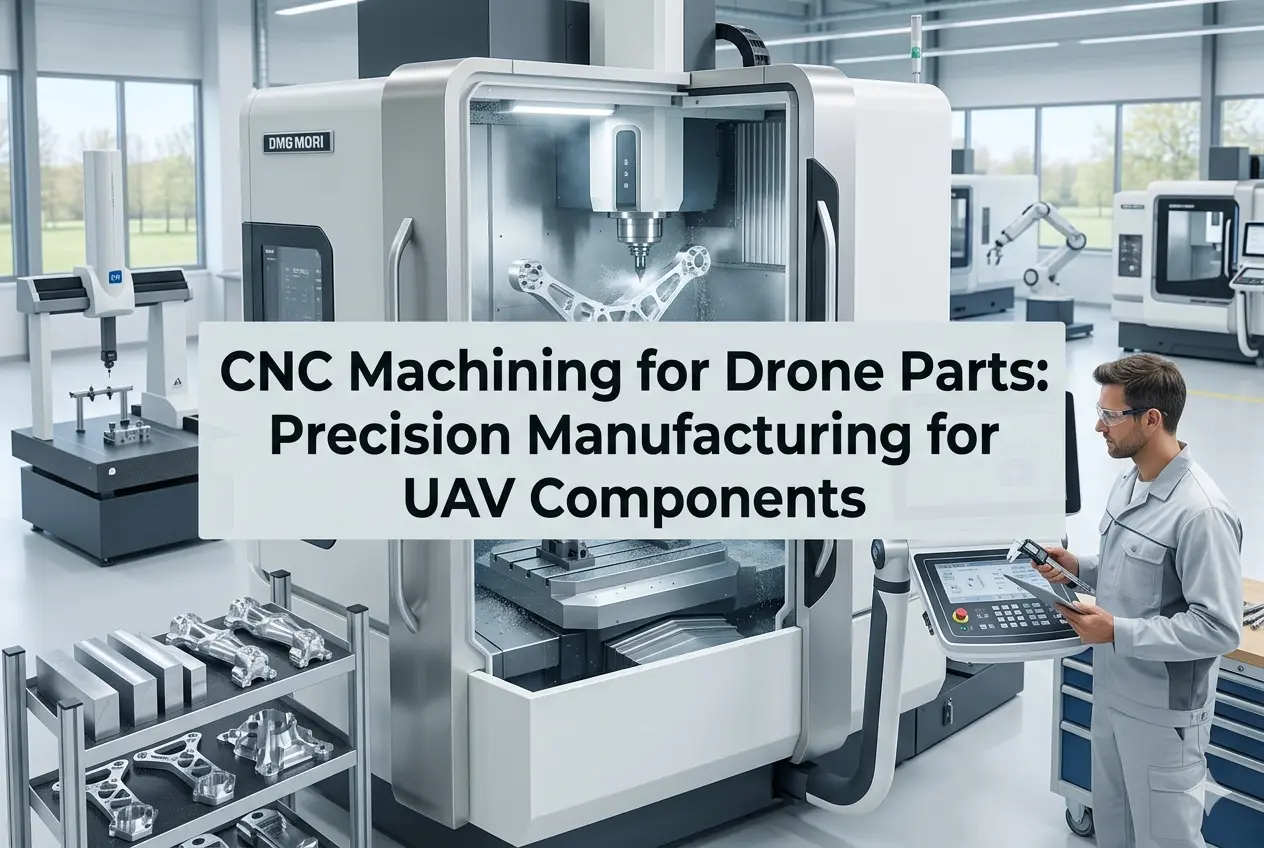
The drone (UAV) industry has rapidly evolved from a niche technology into a core solution across multiple sectors, including aerial photography, industrial inspection, agriculture, logistics, and defense applications. As drone systems become more advanced, the demand for higher precision, better structural efficiency, and improved flight stability continues to grow. In this context, CNC machining has become one of the most critical manufacturing technologies supporting modern UAV development.
At its core, a drone is a highly sensitive electromechanical system where every component contributes to flight performance. Even minor dimensional deviations in structural parts can lead to vibration issues, unstable flight behavior, or reduced endurance. This is why manufacturing precision is not optional—it is essential. CNC machining (Computer Numerical Control machining) provides the level of accuracy and repeatability required to meet these strict engineering demands.
Unlike traditional manufacturing methods, CNC machining enables engineers to transform digital CAD models directly into physical components with extremely tight tolerances. This is especially important in UAV development, where design iterations happen quickly and prototypes must be tested in real-world flight conditions within short timeframes. CNC machining allows for rapid prototyping without the need for expensive tooling or molds, significantly reducing development cycles.
Another key reason CNC machining is so important in drone manufacturing is its compatibility with lightweight structural design. Modern UAVs rely heavily on weight reduction strategies to extend flight time and improve maneuverability. CNC machining makes it possible to precisely remove excess material while maintaining structural integrity, allowing engineers to achieve an optimal balance between strength and weight.
In addition, UAV structures often involve complex geometries such as internal cavities, aerodynamic contours, and integrated mounting systems. These features are difficult or impossible to achieve with conventional manufacturing processes. CNC machining—especially multi-axis machining—allows for the production of highly complex geometries in a single setup, reducing errors caused by multiple clamping operations.
Precision requirements in UAV systems are also closely related to system stability. For example, motor alignment, frame symmetry, and sensor positioning must be controlled within extremely tight tolerances. Any deviation can directly impact flight control performance. For a deeper understanding of how precision impacts mechanical systems, you can refer to our engineering insights on robotics manufacturing:
https://weyoungcnc.com/cnc-machining-for-robotics-processes-materials-and-design-best-practices/
Similarly, tolerance stack-up control plays a critical role in ensuring system accuracy in complex assemblies:
https://weyoungcnc.com/cnc-machined-robotics-parts-tolerance-stack-up-and-its-impact-on-robot-accuracy/
Overall, CNC machining is not just a production method for drone components—it is a foundational technology that enables UAV innovation. As drones continue to evolve toward higher performance, longer endurance, and more compact designs, the role of CNC machining will only become more important in shaping the future of the industry.
In UAV manufacturing, not every component requires CNC machining. However, the most critical structural, mechanical, and performance-related parts are almost always produced using CNC processes. These components directly affect flight stability, durability, and system integration accuracy.
The drone frame is the backbone of the entire UAV system. It supports all major subsystems, including propulsion, battery modules, flight controllers, and payload equipment. Because of this, the frame must provide high stiffness while maintaining minimal weight.
CNC machining is widely used to produce aluminum frame structures, particularly in high-performance drones where precision alignment is essential. The arms of the drone (also known as booms) must maintain perfect symmetry to ensure stable flight dynamics. Even slight variations in geometry can lead to vibration or control imbalance during operation.
Advanced UAV designs often incorporate lightweight lattice or hollow structures, which are ideal for CNC milling. These designs significantly reduce weight while maintaining structural rigidity, improving overall flight efficiency.
Motor mounts are among the most critical CNC-machined drone parts because they directly influence propulsion stability. These components must ensure perfect alignment between the motor shaft and the drone frame to minimize vibration and energy loss.
CNC machining guarantees tight dimensional accuracy in motor mounting holes, ensuring that each motor operates with optimal balance. Propeller adapters and hubs are also commonly CNC-machined to maintain rotational symmetry, which is essential for reducing oscillation at high speeds.
Landing gear components must absorb impact forces during takeoff and landing while maintaining structural stability. CNC machining allows manufacturers to design lightweight yet strong landing structures with integrated shock-absorbing geometries.
In industrial UAV applications, landing gear often includes folding mechanisms or vibration damping features. These complex mechanical designs are best achieved through multi-axis CNC machining, which enables precise shaping without compromising strength.
Drones rely on sensitive electronic systems such as flight controllers, GPS modules, and communication systems. These components must be protected from environmental stress, vibration, and electromagnetic interference.
CNC-machined housings provide excellent dimensional accuracy and thermal management capabilities. Aluminum enclosures, for example, can be designed with integrated heat dissipation channels to improve system cooling efficiency while maintaining structural protection.
Battery enclosures also benefit from CNC machining due to the need for precise fitment and safety-critical design constraints.
As drones become more modular, the demand for high-precision connectors and mounting interfaces continues to increase. These small but critical components ensure that different UAV modules fit together accurately and securely.
CNC machining enables the production of connectors with tight tolerances, ensuring structural stability and reducing assembly errors during production.
In complex robotic systems, similar precision requirements are critical for mechanical stability, as discussed here:
https://weyoungcnc.com/cnc-machining-for-robotics-processes-materials-and-design-best-practices/
Overall, CNC machining is essential for nearly all performance-critical UAV components, making it the backbone of modern drone manufacturing.
CNC machining has become the preferred manufacturing method for UAV components because it offers a unique combination of precision, flexibility, and performance optimization. Drones operate under highly demanding conditions where even minor manufacturing inconsistencies can significantly impact flight behavior. CNC machining directly addresses these challenges.
One of the most important requirements in drone manufacturing is dimensional accuracy. UAV systems depend on perfectly balanced structures to maintain stable flight. CNC machining provides extremely tight tolerances, often within ±0.01mm, ensuring that every part meets strict engineering specifications.
More importantly, CNC machining ensures repeatability in mass production. This means that every drone component produced in a batch maintains identical dimensions, which is critical for scalable manufacturing and consistent performance.
CNC machining supports a broad range of engineering materials used in UAV production. These include aluminum alloys such as 6061 and 7075, titanium for high-end applications, and engineering plastics like PEEK or Nylon for lightweight and insulated components.
This flexibility allows engineers to select materials based on performance requirements rather than manufacturing limitations.
Modern drone designs often require complex geometrical structures, including internal cavities, aerodynamic surfaces, and integrated mounting systems. CNC machining—especially 5-axis machining—enables the production of these complex geometries in a single setup.
This reduces assembly errors and improves structural accuracy while enabling more innovative UAV designs.
One of the key challenges in drone engineering is balancing structural strength with weight reduction. CNC machining allows for precise material removal strategies, such as pocketing and lattice structures, to reduce weight without compromising durability.
This optimization directly improves flight time, payload capacity, and overall UAV efficiency.
The UAV industry is highly iterative, requiring rapid design testing and frequent modifications. CNC machining supports fast prototyping without the need for tooling, making it ideal for R&D and low-volume production.
Compared to injection molding, which requires expensive molds and long lead times, CNC machining offers significantly faster turnaround, enabling companies to bring products to market more quickly.
CNC machining plays a central role in the production of high-performance UAV components because different drone parts require different machining strategies. From lightweight structural frames to precision motor mounts, each component depends on specific CNC processes to achieve the required accuracy, strength, and surface quality.
CNC milling is the most widely used process in drone manufacturing. It is ideal for producing complex 3D geometries such as drone frames, arms, and mounting brackets. Multi-axis milling machines allow engineers to create lightweight structures with internal pockets, cutouts, and aerodynamic shapes.
For UAV applications, 3-axis milling is commonly used for simpler flat components, while 4-axis and 5-axis machining are preferred for more advanced geometries. The ability to machine multiple surfaces in a single setup significantly improves dimensional accuracy and reduces cumulative error, which is critical for maintaining flight stability.
CNC turning is used for cylindrical drone parts such as motor shafts, propeller adapters, and rotating connectors. These components require high concentricity and balance to ensure smooth operation at high rotational speeds.
Even minor imbalances in these parts can result in vibration, noise, and reduced motor efficiency. CNC turning ensures that every rotational component is manufactured with strict symmetry and surface precision.
5-axis CNC machining is particularly important for advanced drone designs that involve complex curves, deep cavities, or multi-angle surfaces. This process allows manufacturers to machine intricate parts without repositioning the workpiece, reducing setup time and improving accuracy.
In high-end UAV systems, 5-axis machining is often used for integrated frame structures and aerodynamic components where both weight reduction and structural integrity must be carefully balanced.
After machining, drone components often undergo finishing processes such as anodizing, bead blasting, or polishing. These treatments improve corrosion resistance, enhance durability, and optimize surface smoothness for aerodynamic performance.
Surface quality is especially important for UAV frames, where airflow efficiency can directly influence flight endurance.
Material selection is one of the most critical factors in UAV design. The performance, weight, durability, and cost of drone components are all directly influenced by the material used. CNC machining supports a wide range of engineering materials, making it highly suitable for drone manufacturing.
Aluminum is the most commonly used material in CNC-machined drone parts due to its excellent strength-to-weight ratio and machinability.
These materials are ideal for drone frames, motor mounts, and structural brackets.
Titanium is used in advanced UAV systems where maximum strength and durability are required. Although more expensive and harder to machine, titanium offers exceptional mechanical properties, including high fatigue resistance and excellent corrosion resistance.
It is commonly used in military drones or industrial UAVs operating in harsh environments.
Engineering plastics are increasingly used in UAV manufacturing to reduce weight and improve electrical insulation. Materials such as PEEK and Nylon offer excellent mechanical stability while being significantly lighter than metals.
These materials are often used in internal housings, insulation components, and non-load-bearing structures.
In modern drone design, hybrid structures combining aluminum and carbon fiber are becoming more common. CNC machining is often used to create precise interfaces between metal and composite components, ensuring structural integrity and alignment.
Material selection must always balance weight, strength, thermal performance, and cost to achieve optimal UAV performance.
Design plays a crucial role in ensuring that CNC-machined drone parts meet performance and manufacturing requirements. Poor design decisions can lead to excessive weight, structural weaknesses, or assembly difficulties.
One of the most important design goals in UAV engineering is reducing weight without compromising strength. CNC machining allows designers to incorporate internal pocketing, lattice structures, and optimized wall thickness to minimize material usage.
Every gram saved contributes directly to longer flight time and improved payload capacity.
Drones operate under constant vibration from motors and external airflow. Therefore, structural designs must minimize resonance and distribute stress evenly across the frame.
Reinforced mounting points and symmetrical layouts are commonly used to improve stability during flight.
Electronic components such as flight controllers and power systems generate heat during operation. CNC-machined aluminum housings can be designed with integrated heat dissipation channels to improve cooling efficiency.
Proper thermal design ensures system reliability and extends component lifespan.
Drone components must be easy to assemble while maintaining high precision alignment. Designers must consider fastening methods, tolerance clearance, and modularity.
Poor interface design can lead to misalignment issues that negatively affect flight performance.
For deeper insight into design best practices for CNC components, especially in robotics and high-precision systems, you can refer to:
https://weyoungcnc.com/cnc-machining-for-robotics-processes-materials-and-design-best-practices/
Precision and consistency are critical in UAV manufacturing. Even the smallest dimensional variation can significantly affect flight behavior, making tolerance control and quality assurance essential parts of the CNC machining process.
Most UAV components require tight tolerances, often in the range of ±0.01mm to ±0.05mm depending on their function. Structural symmetry, motor alignment, and sensor positioning all depend on precise dimensional control.
Motor mounts, in particular, require extremely accurate hole positioning to ensure proper alignment and minimize vibration during operation.
In complex UAV assemblies, multiple components interact with each other. Even if each part is within tolerance individually, accumulated deviations (tolerance stack-up) can affect the final system performance.
This is especially critical in multi-part assemblies such as drone frames or modular payload systems. A detailed engineering discussion of tolerance stack-up effects can be found here:
https://weyoungcnc.com/cnc-machined-robotics-parts-tolerance-stack-up-and-its-impact-on-robot-accuracy/
To ensure consistency, CNC-machined UAV parts undergo strict quality control processes, including:
These inspection methods ensure that every part meets design specifications before assembly.
Surface roughness also plays an important role in UAV performance. Smoother surfaces reduce air resistance and improve aerodynamic efficiency. Depending on application requirements, surface finishes such as anodizing or polishing are applied to improve both durability and performance.
For commercial UAV production, consistency across batches is essential. CNC machining ensures that each part produced matches the original design with minimal variation, which is crucial for scalable manufacturing.
When selecting a manufacturing method for drone components, engineers often compare CNC machining with other common technologies such as 3D printing and injection molding. Each method has its own strengths, but for high-performance UAV applications, CNC machining remains the most balanced and reliable solution.
3D printing (additive manufacturing) is widely used for rapid prototyping due to its flexibility and low setup cost. It allows engineers to quickly validate designs and produce complex geometries without tooling. However, it has limitations in mechanical strength, surface finish, and material performance.
CNC machining, on the other hand, uses solid engineering materials such as aluminum and titanium, resulting in significantly stronger and more durable components. For functional drone parts such as frames, motor mounts, and structural brackets, CNC machining provides superior mechanical stability and long-term reliability.
While 3D printing is ideal for early-stage prototypes, CNC machining is preferred for functional testing and final production.
Injection molding is highly efficient for large-scale production of plastic parts. However, it requires expensive molds and long lead times, making it unsuitable for early-stage UAV development or low-volume production.
CNC machining does not require tooling, which makes it significantly faster and more flexible. Design changes can be implemented immediately without additional cost, which is critical in the fast-moving drone industry.
For low to medium volume production or custom UAV systems, CNC machining offers a much better cost-performance balance.
Overall, CNC machining provides the best combination of precision, strength, material flexibility, and production speed. It is especially suitable for high-performance drones where structural reliability and tight tolerances are non-negotiable.
CNC-machined components are used across nearly every category of UAV applications, from consumer drones to advanced industrial and defense systems. The versatility of CNC machining allows it to support a wide range of performance requirements and design complexities.
In consumer drones, CNC machining is commonly used for lightweight frames, motor mounts, and camera gimbals. These parts require precision alignment to ensure stable flight and smooth image capture.
Industrial drones used for infrastructure inspection, mapping, and surveying rely on durable CNC-machined housings and structural frames. These drones often operate in harsh environments, requiring high-strength materials and precise engineering.
Agricultural drones require large payload capacity and long endurance. CNC-machined components help optimize weight distribution while maintaining structural integrity for spraying systems and tank mounts.
Defense-grade drones demand extremely high reliability, precision, and durability. CNC machining is widely used to produce mission-critical structural components and protective enclosures.
FPV racing drones require ultra-lightweight yet strong frames. CNC machining enables the production of optimized structures that improve speed, agility, and crash resistance.
At WeYoung CNC, precision manufacturing is not just a production standard—it is a core engineering principle. UAV components require extremely tight tolerances and consistent quality to ensure stable flight performance and long-term reliability.
We use advanced CNC machining centers, including 3-axis, 4-axis, and 5-axis machines, to produce complex drone components with high accuracy. Multi-axis machining reduces setup errors and ensures better geometric consistency.
Every UAV component is manufactured under strict tolerance control guidelines. Depending on the part function, tolerances are typically controlled within ±0.01mm to ±0.05mm to ensure structural precision and assembly compatibility.
Each part undergoes multiple inspection stages, including:
This ensures every component meets engineering specifications before delivery.
We also provide Design for Manufacturability (DFM) support to help customers optimize their drone designs for better performance, lower cost, and improved manufacturability.
For related engineering insights in robotics and precision systems, you can also refer to:
https://weyoungcnc.com/cnc-machining-for-robotics-processes-materials-and-design-best-practices/
Choosing the right CNC manufacturing partner is critical for UAV success. Drone performance depends not only on design but also on manufacturing consistency, material quality, and engineering support.
A professional CNC manufacturer ensures that every component meets strict engineering standards, reducing the risk of mechanical failure during flight.
Experienced CNC suppliers can significantly reduce lead times by streamlining production workflows and offering rapid prototyping services. This allows UAV companies to accelerate product development.
For commercial drone production, consistency is essential. Professional CNC machining ensures that every batch of parts maintains identical precision and quality standards.
Beyond manufacturing, professional suppliers also provide engineering insights, helping optimize part design, reduce weight, and improve structural efficiency.
The UAV industry is moving toward higher performance, longer flight endurance, and more compact structural designs. As these demands increase, CNC machining will continue to play a central role in enabling innovation.
With advancements in multi-axis machining, automation, and precision engineering, CNC technology is becoming even more capable of producing complex, lightweight, and high-strength drone components.
In the future, we will see deeper integration between CNC machining and digital manufacturing systems, allowing faster iteration cycles and higher customization levels for UAV applications.
Ultimately, CNC machining is not just supporting drone manufacturing—it is shaping the future of UAV design and performance.
The most commonly used materials include aluminum alloys (6061, 7075), titanium, and engineering plastics such as PEEK and Nylon. These materials offer an optimal balance of strength and weight.
3D printing is better for rapid prototyping, but CNC machining is superior for functional and production-grade drone parts due to higher strength, precision, and material performance.
CNC machining can typically achieve tolerances between ±0.01mm and ±0.05mm, depending on part complexity and material.
Common CNC-machined drone parts include frames, motor mounts, propeller adapters, landing gear, and electronic housings.
Because drones require lightweight structures with high precision and repeatability, CNC machining ensures consistent performance, stability, and durability.
