Address
304 North Cardinal St.
Dorchester Center, MA 02124
Work Hours
Monday to Friday: 7AM - 7PM
Weekend: 10AM - 5PM

Address
304 North Cardinal St.
Dorchester Center, MA 02124
Work Hours
Monday to Friday: 7AM - 7PM
Weekend: 10AM - 5PM

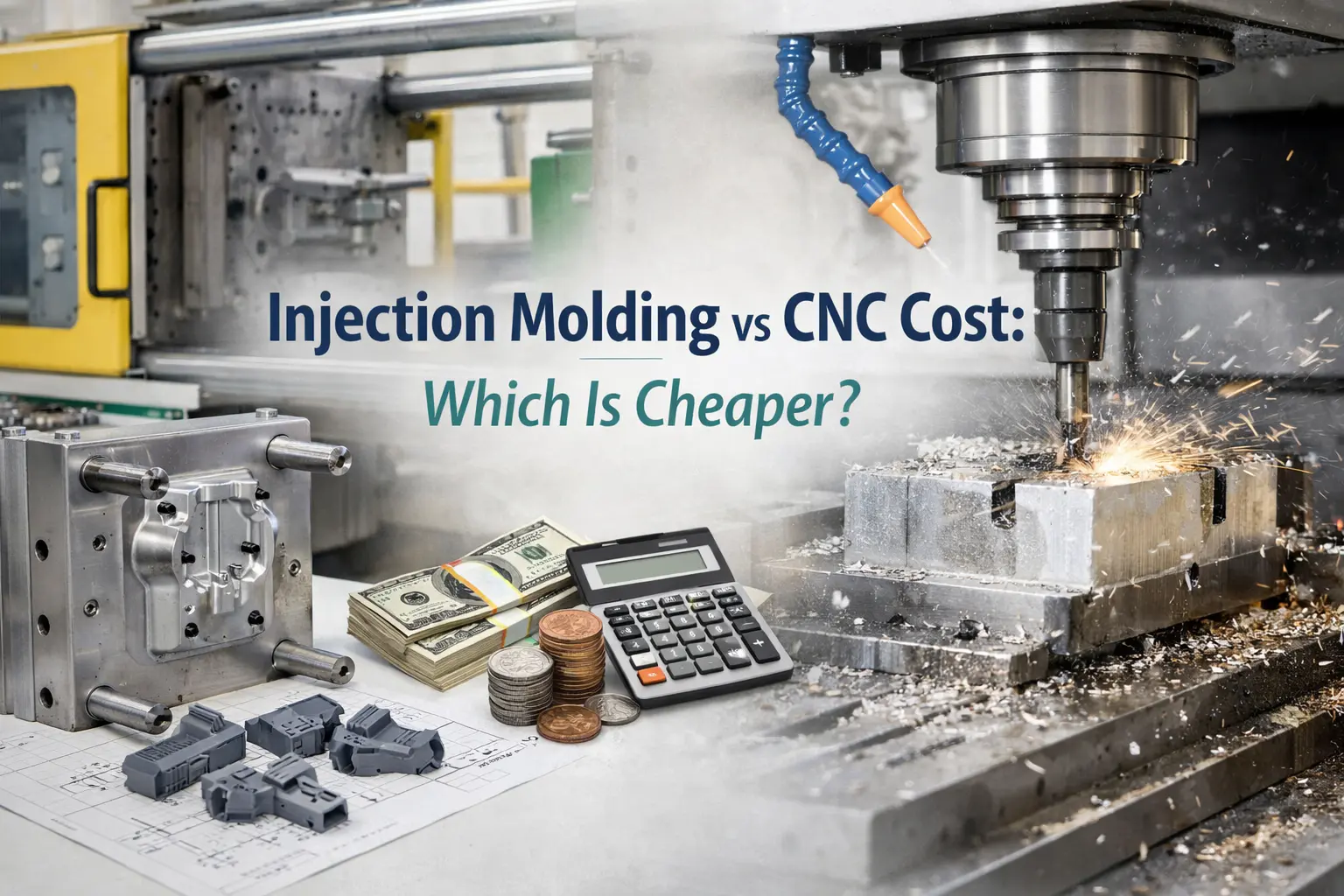
In modern manufacturing, cost is one of the most critical factors influencing product development decisions. Whether a company is producing rapid prototypes, low-volume functional parts, or high-volume consumer components, the choice between CNC machining and injection molding can significantly impact total project cost, lead time, and final product quality. Understanding the cost structure behind these two processes is essential for engineers, product designers, and procurement teams.
CNC machining is widely used for precision metal and plastic parts due to its flexibility and fast turnaround. Injection molding, on the other hand, dominates in mass production environments where unit cost reduction is the primary goal. However, the misconception that one process is universally cheaper than the other often leads to inefficient manufacturing decisions.
In reality, cost comparison is not just about unit price. It involves tooling investment, material usage, production volume, design complexity, and lead time considerations. For example, CNC machining eliminates mold costs but has higher per-unit machining time. Injection molding requires high upfront tooling investment but significantly reduces per-part cost at scale.
To make the right decision, engineers must evaluate both processes from a lifecycle cost perspective rather than a single pricing factor. This is especially important in industries like robotics, automotive, aerospace, and consumer electronics, where production volume can vary from prototype stage to mass production.
For deeper understanding of material selection in molding processes, you can refer to this guide:
https://weyoungcnc.com/guide-to-plastic-injection-molding-materials-types-properties-and-applications/
Similarly, when comparing machining strategies, process selection also plays a key role in cost efficiency:
https://weyoungcnc.com/cnc-turning-vs-milling-complete-comparison-and-practical-guide/
CNC machining cost is primarily influenced by machine time, material selection, design complexity, and post-processing requirements. Unlike injection molding, CNC does not require custom tooling, which significantly reduces initial setup cost. This makes CNC machining highly attractive for prototyping and low-volume production.
However, the absence of tooling shifts cost burden to per-part production time. Every component must be machined individually or in small batches, meaning machining time directly affects pricing.
Material selection plays a major role in CNC cost. Common materials include aluminum, stainless steel, brass, and engineering plastics like POM or ABS. Metals generally increase machining cost due to tool wear and longer cutting time. Additionally, CNC machining is a subtractive process, meaning material waste is higher compared to injection molding.
Complex geometries requiring removal of large material volumes will further increase cost. Therefore, design optimization is essential to reduce unnecessary material removal and improve machining efficiency.
CNC machine time is one of the most expensive cost components. The complexity of a part determines how long it stays on the machine. Multi-axis operations, especially 5-axis machining, significantly increase cost due to advanced programming and setup requirements.
For reference, you can learn more about machining process differences here:
https://weyoungcnc.com/cnc-turning-vs-milling-complete-comparison-and-practical-guide/
Setup cost is another key factor. Although CNC does not require molds, each new part design requires CAM programming, tool selection, and fixture setup. These non-recurring engineering (NRE) costs are distributed across production volume, meaning low-volume orders carry higher per-unit cost.
CNC parts often require additional finishing processes such as anodizing, polishing, sandblasting, or coating. These processes improve surface quality and corrosion resistance but also increase total manufacturing cost. In high-precision industries like robotics or aerospace, these finishing steps are often mandatory, further impacting budget.
Overall, CNC machining offers low startup cost and high flexibility but becomes less cost-effective as production volume increases.
Injection molding cost structure is fundamentally different from CNC machining. The most significant cost component is mold tooling. Mold design and fabrication require high-precision machining, often involving hardened steel or aluminum molds depending on production requirements.
Tooling cost can range from a few thousand dollars for simple molds to tens of thousands for complex multi-cavity or high-tolerance molds. This upfront investment is the primary barrier to entry for injection molding.
However, once the mold is produced, it can be used for hundreds of thousands or even millions of cycles, drastically reducing per-unit cost.
Injection molding becomes highly cost-efficient at scale. After tooling investment is amortized, the cost per part drops significantly compared to CNC machining. This is because cycle time per part is relatively short, often ranging from a few seconds to a few minutes depending on part size and complexity.
Material efficiency is another advantage. Unlike CNC machining, injection molding produces minimal waste since material is injected directly into the mold cavity. This makes it ideal for thermoplastics such as ABS, PC, Nylon, and PEEK.
For a deeper understanding of material properties and selection in injection molding, refer to:
https://weyoungcnc.com/guide-to-plastic-injection-molding-materials-types-properties-and-applications/
Although injection molding is cost-effective in mass production, mold maintenance must also be considered. Over time, molds experience wear, requiring polishing, repair, or even replacement depending on production volume and material abrasiveness.
Additionally, design changes after mold creation can be expensive. Unlike CNC machining, where design iteration is easy, injection molding requires mold modification or new tooling, increasing overall development cost.
Injection molding typically has longer initial lead time due to mold manufacturing. However, once production begins, it is the fastest and most scalable method for producing identical parts at low cost per unit.
This makes injection molding ideal for stable, high-volume production where design is finalized and long-term manufacturing efficiency is the priority.
When comparing CNC machining and injection molding, the most fundamental difference lies in how cost is distributed across production stages. CNC machining is a low initial cost but high per-unit cost process, while injection molding is a high upfront cost but extremely low per-unit cost solution.
In CNC machining, there is no need for tooling. Each part is directly machined from raw material using programmed tool paths. This makes CNC highly flexible and ideal for design iterations, prototypes, and small batch production. However, every additional part requires machine time, operator input, and tooling wear, which keeps unit cost relatively high.
Injection molding, in contrast, requires significant upfront investment in mold design and manufacturing. Once the mold is completed, the production cycle becomes extremely efficient. Each injection cycle can produce one or multiple identical parts within seconds, dramatically reducing per-part cost at scale.
CNC machining offers unmatched flexibility. Design changes can be implemented immediately without additional tooling cost. Injection molding, however, locks the design once the mold is created, making changes expensive and time-consuming.
This trade-off defines the core decision-making process: CNC is optimized for flexibility, while injection molding is optimized for scale and cost efficiency.
The break-even point between CNC machining and injection molding occurs when the total cost of injection molding becomes lower than CNC machining for the same number of parts.
This break-even point depends on three key variables:
At low volumes (typically 1–1000 parts), CNC machining is almost always more cost-effective because it avoids tooling costs. However, as volume increases, the high tooling cost of injection molding is gradually amortized over more units, significantly reducing per-part cost.
In most manufacturing scenarios:
However, this range is not fixed. Complex geometries, tight tolerances, and expensive mold designs can shift the break-even point higher.
For example, a simple plastic housing may require a $5,000 mold. If CNC cost per part is $20, injection molding becomes cheaper once production exceeds a few hundred units. But for more complex parts requiring a $20,000 mold, the break-even point may shift to several thousand units.
This is why early-stage DFM (Design for Manufacturability) analysis is critical before selecting a process.
CNC machining has a major advantage in lead time. Since no mold is required, production can begin almost immediately after design finalization. Typical lead time includes:
This makes CNC ideal for urgent prototypes, engineering validation, and small batch production where speed is critical.
Injection molding requires significantly longer initial lead time due to mold design, machining, assembly, and testing. This process can take several weeks depending on complexity.
However, once the mold is completed, production speed becomes extremely fast. Thousands of identical parts can be produced in a short time with consistent quality.
The key trade-off is simple:
For many companies, CNC is used for prototyping, while injection molding is adopted once design is finalized and demand is stable.
In CNC machining, part geometry directly impacts cost. Key cost-driving factors include:
Simplifying geometry and reducing unnecessary precision requirements can significantly reduce CNC cost.
For injection molding, cost is primarily driven by mold complexity. Key factors include:
Poor design decisions can dramatically increase mold cost and production complexity.
Design for Manufacturability (DFM) plays a critical role in both processes. Early collaboration with manufacturing engineers can help reduce cost, improve efficiency, and avoid redesigns.
For plastic material selection and design considerations in molding, you can refer to this guide:
https://weyoungcnc.com/guide-to-plastic-injection-molding-materials-types-properties-and-applications/
For machining strategy optimization, understanding process differences is also essential:
https://weyoungcnc.com/cnc-turning-vs-milling-complete-comparison-and-practical-guide/
Choosing between CNC machining and injection molding is not only a cost decision, but also an application-driven engineering decision. Different industries prioritize different factors such as precision, scalability, material performance, and lead time.
CNC machining is widely used in industries that require high precision, tight tolerances, and fast iteration cycles, including:
CNC is especially valuable in early-stage product development where design changes are frequent and production quantities are limited.
Injection molding dominates industries where high-volume production and cost efficiency per unit are critical, such as:
Once product design is finalized, injection molding becomes the most cost-effective solution for scaling production.
| Factor | CNC Machining | Injection Molding |
|---|---|---|
| Initial Cost | Low | High (mold required) |
| Unit Cost | High | Very low (at scale) |
| Lead Time | Short | Long (initial tooling) |
| Production Volume | Low to medium | Medium to very high |
| Design Flexibility | Very high | Low after mold creation |
| Material Waste | Higher | Minimal |
| Precision | Very high | High (depends on mold quality) |
CNC machining is optimized for flexibility and speed, while injection molding is optimized for scale and cost efficiency. The right choice depends entirely on production volume and product lifecycle stage.
One of the most effective ways to reduce cost is early-stage design optimization. Simplifying geometry, avoiding unnecessary complexity, and standardizing features can significantly reduce both CNC machining time and mold cost in injection molding.
Material selection directly affects cost, machining difficulty, and production efficiency. For CNC machining, softer metals or engineering plastics can reduce tool wear and processing time. For injection molding, selecting widely available thermoplastics reduces material cost and cycle time.
For detailed material selection guidance, refer to:
https://weyoungcnc.com/guide-to-plastic-injection-molding-materials-types-properties-and-applications/
Batch size plays a critical role in cost efficiency. Small batches favor CNC machining, while larger batches justify injection molding investment. Proper production planning can help reduce overall lifecycle cost.
Excessively tight tolerances or unnecessary precision requirements often increase cost without improving product performance. Engineering specifications should always align with functional requirements.
A professional manufacturing partner provides not only production capability but also engineering optimization support. This includes material selection advice, design review, and process selection guidance.
Experienced suppliers can identify cost-saving opportunities early in the design phase, helping avoid expensive redesigns or tooling changes later.
A reliable partner can support you from prototype stage to mass production, allowing seamless transition between CNC machining and injection molding as your product scales.
At WeYoung CNC, we provide integrated manufacturing solutions including CNC machining, injection molding, rapid prototyping, and low-volume production, helping customers achieve both speed and cost efficiency.
The cost comparison between CNC machining and injection molding depends entirely on production volume and project stage.
The key decision factor is the break-even point, where injection molding starts to outperform CNC machining in unit cost. Before reaching that point, CNC is usually the most economical and flexible solution.
In many real-world projects, both processes are used together—CNC for prototyping and injection molding for final production.
Yes, CNC machining is generally cheaper for low-volume production because it does not require mold tooling.
Typically between 3,000 and 10,000 units, depending on mold cost and part complexity.
CNC machining is faster for initial production, while injection molding is faster for mass production after tooling is completed.
No. CNC is ideal for prototypes and low volume, while injection molding is required for high-volume production efficiency.
CNC machining usually provides higher precision, while injection molding depends on mold quality and material shrinkage.
