Address
304 North Cardinal St.
Dorchester Center, MA 02124
Work Hours
Monday to Friday: 7AM - 7PM
Weekend: 10AM - 5PM

Address
304 North Cardinal St.
Dorchester Center, MA 02124
Work Hours
Monday to Friday: 7AM - 7PM
Weekend: 10AM - 5PM
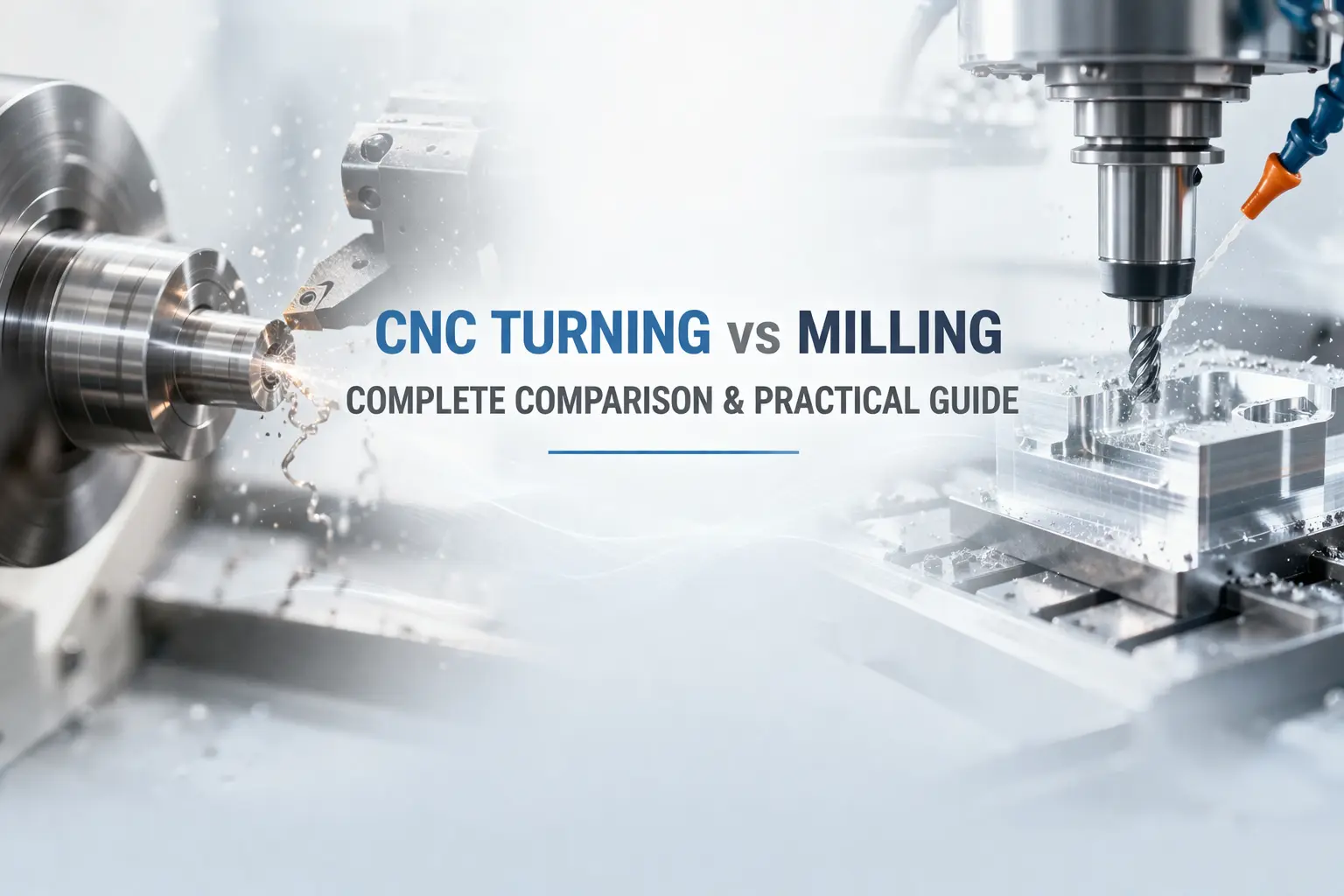
In modern manufacturing, CNC turning and milling are two of the most essential machining processes. These processes form the backbone of precision manufacturing across industries such as aerospace, automotive, medical devices, and industrial machinery. The choice between turning and milling can dramatically impact not only the efficiency of production but also the quality, cost, and functional performance of the final part. CNC machines have revolutionized these processes, allowing for unmatched precision, repeatability, and automation, making it possible to achieve complex geometries that would be difficult or impossible with manual machining.
CNC turning involves rotating the workpiece against a stationary cutting tool, which makes it particularly effective for producing cylindrical parts, such as shafts, bushings, and threaded rods. Milling, on the other hand, rotates the cutting tool against a stationary or semi-fixed workpiece, enabling the creation of flat surfaces, slots, pockets, contours, and highly intricate 3D shapes. Both processes are classified as subtractive manufacturing, meaning material is removed from a solid block or bar to achieve the desired shape. This fundamental similarity allows engineers to approach both processes with a shared understanding of cutting forces, material behavior, and tool dynamics, but the differences in motion and tooling create distinct capabilities and limitations.
Understanding the practical and technical differences between CNC turning and milling is critical for design engineers, machinists, and production planners. Selecting the wrong process can lead to unnecessary production time, excessive tool wear, poor surface finish, or even part failure in demanding applications. Conversely, making an informed choice optimizes machine time, reduces material waste, and ensures consistent part quality. Additionally, the integration of CNC software and automation allows for complex workflows, multi-axis machining, and hybrid operations that combine turning and milling, providing an even broader toolkit for precision manufacturing. For instance, for specialized milling applications such as form milling, which involves cutting complex contours and profiles on a workpiece, manufacturers can achieve highly accurate shapes that are critical for molds, aerospace components, or intricate mechanical parts. You can learn more about form milling techniques and their applications in this detailed guide: A Complete Guide to Form Milling: How It Works and Where It’s Used.
The importance of these machining processes is also reflected in industry trends. As manufacturing moves toward higher automation, faster lead times, and smaller batch sizes, both turning and milling must adapt. CNC turning is often preferred for long, cylindrical, or rotationally symmetric parts due to its efficiency in producing high volumes with consistent tolerances. Milling shines when the design demands multi-axis cutting, surface flatness, or complex 3D features. Companies like WeYoung CNC focus on delivering both turning and milling services, offering rapid manufacturing solutions that meet tight deadlines without compromising on quality. In summary, understanding CNC turning and milling is not just about knowing which machine to use; it is about optimizing the entire production workflow, from material selection to post-processing, to achieve high-performance, cost-effective, and reliable parts.
CNC turning and milling represent two fundamental approaches to material removal in machining, each with unique operational mechanics, toolsets, and applications. Grasping the basics of both processes is essential for manufacturers aiming to achieve precise geometries and efficient production cycles.
CNC turning is performed on a lathe, where the workpiece is securely clamped and rotated along its axis while a cutting tool moves linearly to remove material. This process is particularly suitable for cylindrical components such as shafts, pins, bushings, threaded rods, and pulleys. The rotation of the workpiece allows the cutting tool to remove material continuously, producing smooth surfaces and precise diameters. CNC turning can also incorporate drilling, grooving, and threading operations, often in a single setup, which enhances efficiency and reduces handling errors. High-precision CNC lathes are capable of producing parts with tight tolerances and excellent surface finishes, often in the range of microns.
The choice of tooling is critical in turning operations. Single-point tools are commonly used, allowing precise cutting angles and depth control. The material type—whether aluminum, steel, brass, or plastic—affects cutting speed, feed rate, and tool wear. Proper lubrication and coolant usage are essential to maintain tool life and prevent heat-induced deformation, especially for metals prone to work hardening.
CNC milling, in contrast, involves a stationary or semi-fixed workpiece and a rotating cutting tool. Milling machines can move the tool in multiple axes (typically X, Y, and Z, with advanced machines offering up to 5 axes) to achieve flat surfaces, slots, pockets, and intricate 3D geometries. This flexibility makes milling ideal for producing complex mechanical parts, molds, and dies. Depending on the design requirements, milling can be performed using end mills, face mills, ball-nose cutters, or form cutters.
Milling operations can be divided into peripheral milling, where the cutting edges of the tool remove material along the periphery of the workpiece, and face milling, which focuses on removing material across a large surface area. Advanced milling operations, such as side milling, enable precise cutting along vertical or angled surfaces, critical for aerospace or automotive components. You can explore more about side milling techniques and their industrial applications here: Side Milling in CNC Machining: Process, Techniques, and Types Explained.
While both processes are subtractive, the direction of motion and tool engagement create distinct advantages. Turning excels in producing high-volume cylindrical parts with consistent diameters, while milling offers unmatched flexibility for complex shapes and 3D contours. Both processes require careful planning of cutting parameters, tool selection, and fixturing to ensure efficiency and high-quality output. Understanding these fundamental differences allows engineers to strategically choose the optimal process or combine both in hybrid workflows, ensuring precision, efficiency, and cost-effectiveness.
Although CNC turning and milling operate differently, they share several fundamental similarities that are critical for manufacturing professionals to understand.
At their core, both CNC turning and milling are subtractive processes, meaning material is progressively removed from a solid workpiece to achieve the desired geometry. This requires an understanding of cutting forces, material behavior, and heat management to prevent tool wear, deformation, or surface defects. Engineers must consider how the material responds to cutting in both turning and milling, whether it’s aluminum, steel, brass, or specialized alloys.
Both processes rely heavily on CNC control systems, which allow operators to program cutting paths, spindle speeds, feed rates, and tool movements with high accuracy. CNC control enables repeatable, high-precision operations, essential for modern manufacturing where tolerances are often in the micron range. For example, a precision shaft for the automotive industry may require turning for its diameter and milling for flat features, both with extremely tight tolerances.
Turning and milling share similarities in terms of tooling requirements. The choice of cutting tools, inserts, and coatings affects part quality, machining speed, and tool life. Lubrication and coolant strategies are critical in both processes to manage heat and prevent surface damage. Material selection plays a key role: metals like stainless steel or titanium require slower feed rates and more robust tooling, while softer materials like aluminum allow faster operations.
Both processes influence the surface finish of the part. A well-executed turning or milling operation can reduce the need for post-processing such as grinding or polishing, which saves time and cost. Surface finish also affects functional performance, such as wear resistance or sealing capability in mechanical components. In many cases, combining turning and milling in a single part ensures optimal surface quality and geometric accuracy.
Finally, turning and milling are often integrated into hybrid manufacturing workflows, allowing parts to be partially turned and partially milled in the same setup. This integration maximizes efficiency, reduces setup time, and enhances part accuracy. Advanced operations like form milling or side milling complement turning, enabling the production of highly complex components with tight tolerances. Understanding these similarities is crucial for engineers and manufacturers aiming to optimize production, reduce costs, and maintain quality.
CNC turning and milling are both subtractive machining processes widely used in modern manufacturing, yet the differences between them are substantial and influence nearly every aspect of production—from tooling and machine selection to efficiency, precision, and cost. Understanding these differences is critical for engineers, machinists, and production managers seeking to optimize workflow, reduce waste, and ensure high-quality parts.
One of the most fundamental differences between CNC turning and milling lies in the motion of the workpiece and cutting tool. In CNC turning, the workpiece rotates on its axis while the cutting tool moves linearly to remove material. This rotational motion makes turning highly efficient for producing cylindrical or rotationally symmetric parts, such as shafts, bushings, and threaded rods. The continuous rotation allows for uniform cutting and smooth surfaces along the circumference, which is particularly beneficial for high-volume production of identical parts.
In contrast, CNC milling involves a rotating cutting tool that moves relative to a stationary or semi-fixed workpiece. The milling cutter can move along multiple axes—typically X, Y, and Z—with advanced machines offering 5-axis movements for intricate geometries. Milling is ideal for creating flat surfaces, slots, pockets, and complex 3D contours, which are difficult or impossible to achieve with turning alone. The motion dynamics in milling also enable angled cuts, precise surface shaping, and multi-step operations within a single setup, offering versatility unmatched by conventional turning.
This fundamental difference in motion affects not only the type of parts that can be produced but also the machining strategies and cutting parameters. For example, turning relies heavily on maintaining consistent spindle speed and feed rate to ensure smooth surfaces, while milling may require complex toolpath planning to achieve precise contours and avoid collisions in multi-axis machining.
The geometry of the part is a major factor in determining whether turning or milling is more appropriate. Turning excels at producing parts with cylindrical, conical, or rotationally symmetric geometries. Components such as shafts, pins, bushings, and round connectors are most efficiently produced using CNC turning. The process allows for precise diameter control and concentricity, which is critical in applications like automotive driveshafts, hydraulic components, and aerospace fittings.
On the other hand, milling is highly versatile in shaping complex, multi-faceted, and non-rotational geometries. Flat surfaces, slots, holes, pockets, and intricate 3D contours can all be efficiently machined on a milling center. For example, mold cavities, aerospace brackets, and mechanical housings often require multiple axes of milling to achieve the desired features. Advanced techniques such as form milling and side milling allow for highly accurate contours and angled surfaces, enabling the production of components with complex functionality. You can read more about form milling applications in this guide: A Complete Guide to Form Milling: How It Works and Where It’s Used.
Essentially, turning is geometry-specific, excelling at rotational parts, whereas milling is geometry-flexible, capable of producing intricate features and multi-dimensional surfaces.
CNC turning and milling also differ significantly in terms of tooling. Turning tools are generally single-point cutting tools with a precise geometry tailored for external or internal diameters, threading, and grooving. The tool must maintain correct angles, clearances, and depth to ensure smooth cuts and maintain dimensional accuracy. The type of insert, tool coating, and material compatibility are all critical, especially when machining hard alloys like stainless steel or titanium.
Milling tools, by contrast, include a wide range of cutters such as end mills, face mills, ball-nose cutters, and form cutters. Milling tools often have multiple cutting edges, allowing them to remove more material per pass and produce smoother surfaces on complex shapes. The selection of milling tools depends on the type of material, desired surface finish, and geometry. Milling also often requires more frequent tool changes or toolpath adjustments for intricate operations, which increases operational complexity but allows for unmatched design flexibility. Techniques such as side milling are essential for producing vertical faces or angled surfaces on a workpiece; you can find more details in this article: Side Milling in CNC Machining: Process, Techniques, and Types Explained.
The machines used for turning and milling are fundamentally different in design and capability. CNC lathes are optimized for rotational workpieces and typically have one main spindle for part rotation and multiple tool holders to accommodate turning, threading, and grooving tools. Advanced CNC lathes may include live tooling or milling attachments to combine turning and milling operations in a single setup, which reduces part handling and improves precision.
CNC milling machines, on the other hand, are designed to move the cutting tool along multiple axes relative to the workpiece. Milling centers range from 3-axis machines suitable for basic operations to 5-axis machines capable of complex contouring, multi-face machining, and angled cuts. Milling centers are generally more flexible than lathes but may require more setup time for each part and careful programming to avoid collisions and maintain precision.
Turning is often more efficient for high-volume production of cylindrical components. Once a CNC program is optimized, the lathe can produce large quantities of identical parts with minimal operator intervention, consistent quality, and low cycle time. This makes turning the preferred method for shafts, pins, and standard fittings in industries like automotive, oil and gas, and aerospace.
Milling, while flexible, can be slower for high-volume cylindrical parts due to the complex movements and multiple axes involved. However, milling is indispensable for small-batch production or highly complex parts, where design flexibility outweighs raw speed. By combining turning and milling in a hybrid workflow, manufacturers can optimize both efficiency and complexity, achieving fast production without sacrificing design capability.
Both turning and milling can achieve high precision, but their strengths differ. Turning typically excels in diameter accuracy and concentricity, producing smooth cylindrical surfaces with tight tolerances. For example, aerospace shafts or medical implants often require turning to meet strict concentricity and diameter specifications.
Milling, by contrast, is superior for flatness, angular precision, and multi-dimensional features. Milling can produce precise slots, contours, and pockets with excellent surface finishes when proper toolpaths and cutting parameters are used. The combination of turning and milling often ensures both cylindrical precision and complex surface accuracy, essential for advanced mechanical assemblies.
Cost differences between turning and milling arise from tooling, machine time, and setup complexity. Turning is often more cost-effective for simple, high-volume rotational parts because single-point tools are cheaper and cycle times are shorter. Lathes are also generally easier to program for repetitive operations.
Milling, while more versatile, can be costlier due to multi-axis toolpaths, complex programming, and higher tooling expenses. Specialized milling operations such as form or side milling may require custom tools or multiple setups, adding to production cost. However, the ability to produce complex geometries in fewer setups can offset costs for high-complexity or low-volume parts.
| Factor | CNC Turning | CNC Milling |
|---|---|---|
| Motion | Workpiece rotates, tool stationary | Tool rotates, workpiece fixed |
| Part Type | Cylindrical, rotational | Flat, complex, multi-dimensional |
| Tooling | Single-point tools | Multi-edge cutters (end mills, face mills, ball-nose) |
| Machine | CNC Lathe | CNC Milling Center (3-5 axes) |
| Batch Suitability | High-volume, repetitive | Low to medium-volume, complex shapes |
| Precision Strength | Diameter, concentricity | Flatness, contour, complex surfaces |
| Cost | Lower for simple cylindrical parts | Higher for complex shapes and multi-axis operations |
By understanding these differences, engineers and manufacturers can strategically choose the right machining process or combine turning and milling to optimize production, reduce lead time, and improve quality.
CNC turning and milling are widely used across multiple industries, each process serving specific purposes depending on part geometry, tolerances, and production requirements. Understanding their real-world applications not only clarifies when to use each process but also demonstrates how combining both can enhance manufacturing efficiency and part functionality.
In the aerospace sector, components often demand high precision, complex geometries, and strict surface finish requirements. CNC turning is extensively used to manufacture rotational parts such as turbine shafts, landing gear components, and actuator rods. The high concentricity and tight tolerance achievable with turning make it ideal for parts that must withstand high rotational loads and vibrations. Milling, in contrast, is applied to create complex brackets, housings, and aerodynamic surfaces. For example, aerospace structural components often require multi-axis milling to achieve precise contours and pockets that reduce weight while maintaining strength. Advanced techniques such as form milling allow manufacturers to produce intricate profiles on molds and specialized parts with high accuracy. You can learn more about form milling applications here: A Complete Guide to Form Milling: How It Works and Where It’s Used.
Automotive manufacturing relies heavily on both turning and milling. Turning is commonly used for shafts, pins, bushings, and axle components, ensuring smooth rotation and accurate diameters. These parts often need high-volume production with consistent tolerances, making CNC turning the ideal choice. Milling, meanwhile, is essential for producing engine blocks, transmission housings, suspension components, and molds for plastic parts. Milling allows the creation of slots, grooves, and pockets critical for fluid flow, structural reinforcement, or assembly alignment. Techniques like side milling are particularly useful for cutting vertical surfaces and angled features on metal brackets and chassis components, as explained here: Side Milling in CNC Machining: Process, Techniques, and Types Explained.
CNC turning and milling are vital in the production of medical devices and precision instruments, where tight tolerances and surface finishes are non-negotiable. Turning produces cylindrical implants, surgical pins, and prosthetic rods, ensuring accurate diameters and concentricity. Milling enables the fabrication of complex instrument components, bone plates, and customized surgical guides, often from titanium or stainless steel. The ability to combine turning and milling in a single workflow helps medical manufacturers meet strict ISO and FDA standards, ensuring functional reliability and patient safety.
In industrial machinery, components such as gears, rollers, valves, and spindles often require a combination of turning and milling operations. Turning is used to create shafts and cylindrical housings, while milling shapes keyways, slots, and flat mounting surfaces. This combination ensures parts fit precisely and perform reliably under heavy loads. Additionally, milling techniques like form milling are employed to manufacture dies, molds, and tooling components, enabling the mass production of high-precision metal or plastic parts.
Across these applications, the synergy between turning and milling allows manufacturers to produce high-quality parts efficiently, meeting both functional and aesthetic requirements. Understanding the specific role of each process in real-world applications helps engineers optimize production strategies, reduce waste, and improve overall cost-effectiveness.
Selecting the appropriate machining process is a critical decision in manufacturing. While turning and milling share similarities as subtractive processes, each excels under different conditions. This practical guide provides insight into how to choose the optimal process for your part requirements.
The first consideration is part geometry. Cylindrical, rotationally symmetric parts are best suited for CNC turning. If your design includes flat surfaces, complex contours, or multi-dimensional features, milling is usually required. For example, a long cylindrical shaft can be fully produced on a lathe, whereas a housing with pockets, slots, and mounting surfaces will require milling. For highly intricate features, consider using both turning and milling in a hybrid workflow, which reduces setup time and ensures accuracy across all dimensions.
Parts requiring tight concentricity, precise diameters, or smooth cylindrical surfaces are typically produced via turning. Milling is preferable for features requiring flatness, angular precision, or complex 3D surfaces. For parts demanding both types of tolerances—such as a shaft with milled keyways—combining turning and milling ensures functional precision and high-quality surface finishes.
The type of material plays a key role. Metals like aluminum, steel, brass, and titanium respond differently to turning and milling. Softer metals may allow faster milling operations, while harder alloys require specialized tooling for both processes. Some materials, like composites or hardened steel, may require form milling or specialized cutting tools for precise contours. Understanding material properties ensures tool longevity, reduces downtime, and maintains part accuracy.
High-volume production favors turning for cylindrical parts due to fast cycle times and low tool costs. Milling, while versatile, may require longer setup and machining time for complex geometries, making it more suitable for low- to medium-volume runs or highly customized components. When producing parts with mixed features, hybrid operations can combine the efficiency of turning with the flexibility of milling, optimizing production schedules.
Cost considerations are also important. Lathes used for turning are generally simpler and less expensive for producing rotational parts, whereas milling centers—especially multi-axis machines—represent higher capital and operational costs. Tooling for milling can be more expensive due to the complexity of cutters, especially in side or form milling operations. However, the ability to produce complex parts in fewer setups can justify the cost, especially for high-precision or multi-feature components.
Consider how each process affects post-processing. Turning can often achieve smooth cylindrical surfaces that require minimal finishing, whereas milling may need additional finishing operations to achieve desired surface quality. Planning ahead for finishing ensures consistent quality, reduced lead times, and lower overall production costs.
Ultimately, choosing between CNC turning and milling requires balancing geometry, tolerances, material, volume, cost, and finishing requirements. In many cases, the best solution is a combined approach, using turning to produce the primary cylindrical features and milling to add complex contours, slots, or pockets. This integrated approach optimizes both efficiency and part functionality, ensuring high-quality results with minimal waste.
CNC turning and milling are indispensable tools in modern manufacturing, each offering unique advantages and limitations. Turning excels in producing cylindrical, rotationally symmetric parts with tight tolerances and high efficiency, while milling offers unparalleled flexibility for complex, multi-dimensional, and precision geometries. Both processes share similarities in their reliance on CNC control, tool selection, material considerations, and surface finishing, but their operational differences make each suitable for specific applications.
Understanding these differences allows engineers and manufacturers to make informed decisions, whether producing aerospace components, automotive parts, medical devices, or industrial machinery. The integration of turning and milling in hybrid workflows maximizes efficiency, reduces lead times, and ensures consistent, high-quality output. Advanced techniques like form milling and side milling further enhance the capabilities of CNC machining, enabling the production of highly complex components with tight tolerances. By carefully evaluating part geometry, material, volume, and tolerances, manufacturers can optimize the machining process, minimize costs, and deliver precise, functional parts.
For manufacturers looking to leverage both turning and milling for rapid, high-quality production, companies like WeYoung CNC offer comprehensive solutions combining precision, speed, and expertise across both machining methods, ensuring parts meet the highest standards of performance and reliability.
