Address
304 North Cardinal St.
Dorchester Center, MA 02124
Work Hours
Monday to Friday: 7AM - 7PM
Weekend: 10AM - 5PM

Address
304 North Cardinal St.
Dorchester Center, MA 02124
Work Hours
Monday to Friday: 7AM - 7PM
Weekend: 10AM - 5PM
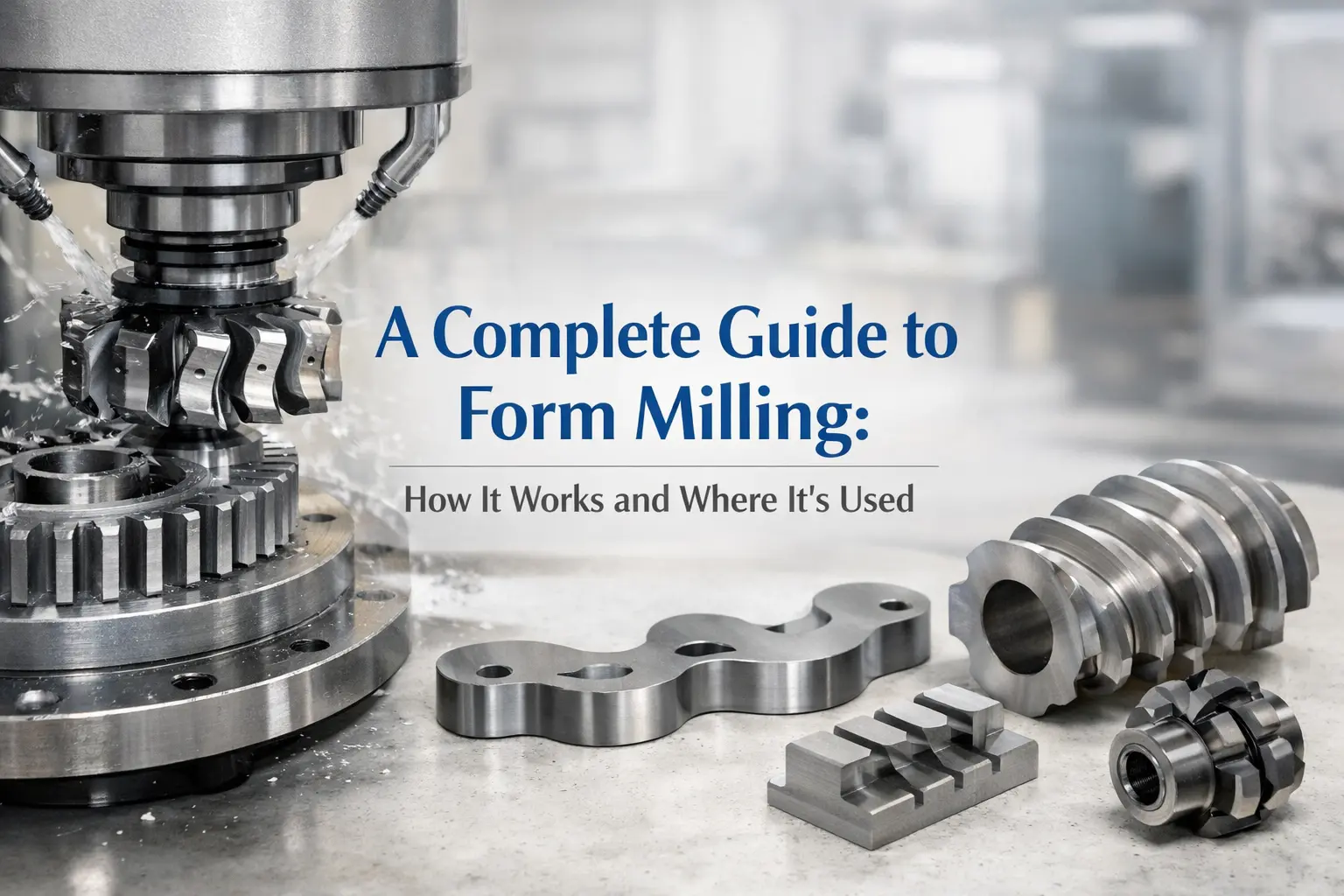
Form milling is a specialized machining process used to create complex shapes, contours, and profiles on a workpiece by following the exact geometry of a pre-designed form. Unlike conventional milling, which primarily removes material along straight or simple curved paths, form milling allows manufacturers to produce intricate surfaces with high precision, making it essential in industries where accuracy and repeatability are critical. This process relies heavily on CNC (Computer Numerical Control) machines, which can interpret detailed CAD (Computer-Aided Design) models and convert them into precise tool paths.
The importance of form milling extends beyond just shaping metal or plastic components. In modern manufacturing, the ability to produce complex parts efficiently can significantly impact product quality, lead times, and overall cost. For example, aerospace components often require highly precise curved surfaces to meet strict aerodynamic and structural standards, while automotive parts may need complex molds for mass production. Form milling provides a solution for both small-scale prototyping and high-volume production, offering consistent results across different materials, including aluminum, steel, brass, and engineering plastics.
For manufacturers looking to integrate form milling into their operations, understanding its principles and applications is critical. If you want to discuss how form milling can fit into your next project or need customized machining solutions, you can contact WeYoung CNC to explore expert guidance and rapid prototyping services. For additional insights on related milling operations, especially techniques that complement form milling, see our guide on Side Milling in CNC Machining.
Form milling works by using a pre-shaped cutter that mirrors the desired profile of the part. The milling cutter moves along the workpiece, removing material precisely according to the intended geometry. The process can involve various motions, such as linear, circular, or helical paths, depending on the complexity of the shape. CNC programming plays a vital role, as it allows the machine to follow exact coordinates, adjust feed rates, and control cutting speeds, ensuring that each cut achieves the required tolerance and surface finish.
The selection of cutting tools is a crucial aspect of form milling. Common tools include form cutters, ball-end mills, and T-slot cutters, each designed for specific contours or surface types. Tool materials and coatings, such as carbide or TiN-coated cutters, help reduce wear and maintain cutting efficiency, especially when machining hard metals. Operators also adjust parameters like spindle speed, feed rate, and depth of cut to optimize tool life and surface quality.
Form milling shares some principles with other CNC milling techniques, such as side milling, but differs in its focus on producing precise profiles and complex contours. For a detailed comparison of side milling and its typical applications, check out our Side Milling in CNC Machining guide. If you’re ready to apply these techniques to your project or need assistance selecting the right tooling and process, you can contact WeYoung CNC for expert support.
Form milling techniques vary depending on the geometry of the part and the desired surface finish. Single-side form milling focuses on shaping one surface of the workpiece, often used for molds or dies. Double-side form milling can simultaneously process both sides, improving efficiency in symmetric components. Edge form milling targets specific edges or corners, which is particularly useful in decorative or functional profiles. Helical or contour form milling allows the cutter to follow complex 3D surfaces, enabling precise aerospace, automotive, or medical parts.
Each technique has its advantages and limitations, and selecting the appropriate method depends on material, tolerance requirements, and production volume. Understanding these variations helps manufacturers optimize both efficiency and cost while achieving the desired precision. For a deeper look at how form milling compares with other CNC operations, such as side milling, refer to our Side Milling in CNC Machining guide.
Successful form milling requires carefully selected tools and equipment that match the geometry and material of the workpiece. The primary cutting tools include form cutters, ball-end mills, and T-slot cutters, each designed to create specific profiles or complex surfaces. Form cutters replicate the desired contour in a single pass, making them ideal for high-precision parts, while ball-end mills allow smooth contouring on 3D surfaces, commonly used in aerospace or medical components. T-slot cutters, on the other hand, are often employed for slots or grooves with defined dimensions.
The choice of tool material and coating is critical for maintaining performance and reducing wear. Carbide tools are widely preferred due to their hardness and resistance to high temperatures, while coatings such as TiN or TiAlN can further extend tool life and improve surface finish. For high-volume production, tool durability directly impacts operational costs, so selecting the right combination is crucial. CNC machines themselves play an equally important role; both vertical and horizontal mills can perform form milling, but factors like rigidity, spindle power, and control system capabilities influence achievable accuracy and repeatability.
Form milling tools and processes often intersect with other CNC milling techniques. For example, side milling may be used for initial roughing operations before finishing a complex form-milled profile, ensuring efficient material removal and reduced cycle times. To understand how side milling complements form milling in practical applications, see our detailed guide on Side Milling in CNC Machining. For expert recommendations on tooling, equipment setup, or CNC programming for your specific part, you can contact WeYoung CNC to discuss solutions tailored to your project.
Form milling offers several advantages that make it indispensable in modern CNC machining. One of the primary benefits is its ability to produce highly precise and intricate shapes in a single setup, reducing assembly needs and improving dimensional consistency. The process is also versatile, capable of handling a wide range of materials including metals like aluminum, steel, and brass, as well as plastics and composites. Additionally, CNC-controlled form milling ensures repeatability across multiple parts, which is critical for both prototyping and mass production.
However, form milling also comes with limitations. The process requires precise programming and careful tool selection, which can increase setup time and upfront engineering costs. Complex forms may demand multiple specialized cutters, raising tooling expenses. Tool wear is another consideration; because form milling often involves continuous contact between the cutter and workpiece surface, selecting the correct feed rate and cutting speed is essential to prevent premature tool failure. Compared to simpler milling operations like side milling, form milling can be less efficient for roughing large volumes of material, which is why many manufacturers combine the two techniques in a single workflow. You can learn more about how side milling complements complex milling operations in our Side Milling in CNC Machining guide.
For projects that demand high precision and complex geometries, the advantages of form milling often outweigh its limitations, especially when executed with expert planning and CNC expertise. If you want guidance on optimizing your machining strategy or minimizing tool wear while maximizing efficiency, contact WeYoung CNC for professional support.
Form milling is widely applied across industries where precise, complex, or contoured components are required. In the automotive sector, it is commonly used to produce intricate molds, dies, and engine components. Aerospace applications include turbine blades, structural components, and aerodynamic surfaces that demand tight tolerances and consistent surface quality. In the medical industry, form milling enables the production of surgical instruments, prosthetics, and implantable devices with complex 3D geometries. Mold-making for consumer products or industrial components is another major application, where the accuracy of form milling ensures high-quality replication and extended mold life.
Many manufacturers integrate form milling with other CNC operations to optimize workflow. For instance, side milling is often used to remove bulk material or shape simple features before applying form milling for precise contours, reducing cycle time and tool load. You can explore this synergy in detail in our Side Milling in CNC Machining guide. Choosing the right combination of machining techniques allows businesses to balance speed, cost, and precision, making form milling a versatile solution for both prototyping and production.
For any company looking to leverage form milling for specialized applications or complex projects, contact WeYoung CNC to discuss tailored solutions, rapid prototyping, and precision manufacturing services.
When designing parts for form milling, the geometry must accommodate the limitations and capabilities of CNC machines and cutting tools. One of the first considerations is tool accessibility. All surfaces that need precise contouring must be reachable by the selected cutter without excessive repositioning or complex fixturing. Deep cavities, narrow slots, or undercuts can require specialized tools or multi-axis machines, which increase both setup time and machining cost. Smooth transitions between surfaces and gradual changes in curvature not only improve surface finish but also reduce tool stress, extending cutter life. Sharp internal corners should generally be avoided unless radius inserts are available, as these can otherwise lead to chatter or premature wear.
Material choice is also critical in the design stage. Hard metals such as stainless steel or titanium require slower feed rates and more robust cutting tools, whereas aluminum or brass can be machined at higher speeds but may be prone to burrs or deflection. Understanding material behavior under cutting conditions allows designers to balance efficiency with part integrity. In addition, tolerances must be realistic: overly tight tolerances may require multiple finishing passes, increasing cycle time, while excessively loose tolerances can compromise part fit and function.
Another key factor is integrating form milling with complementary processes, such as side milling, to maximize efficiency. Roughing with side milling can remove large volumes of material before a form milling pass, which reduces cutting forces on delicate profiles and shortens total cycle time. This approach is particularly effective for large or complex components, where direct form milling of the entire part could be inefficient or risk tool overload. For more insight into combining these techniques, see our Side Milling in CNC Machining guide.
Tool wear is one of the most significant considerations in form milling, as continuous contact between the cutter and workpiece can degrade the tool quickly. Designers can help mitigate wear by specifying features that allow for smoother cutting paths, minimizing sharp transitions or abrupt depth changes. Selecting the correct cutter geometry and coating is essential: carbide tools are standard for harder metals, and coatings like TiN, TiAlN, or DLC improve wear resistance and heat management. Multi-pass strategies, where roughing and finishing cuts are separated, also prolong tool life and maintain surface quality.
CNC programming strategies also play a vital role. Optimizing feed rates, spindle speed, and depth of cut for both roughing and finishing operations ensures consistent results while protecting the tooling. Incorporating lead-in and lead-out movements prevents excessive tool load at the start or end of a cut. Simulation software can help designers and machinists identify potential collisions, excessive forces, or areas of high tool stress before actual machining begins. This proactive approach reduces scrap rates and ensures project timelines are met without sacrificing precision.
Cost efficiency is closely tied to both part design and process planning. Reducing unnecessary complexity in a part’s geometry can minimize the number of specialized cutters required and decrease machining time. Wherever possible, standard tool sizes and stock materials should be used to lower procurement and setup costs. Integrating form milling with secondary operations, such as side milling for roughing or CNC turning for cylindrical features, can significantly reduce production cycles and improve overall throughput.
For designers planning multi-part assemblies, consistency in tolerances and features across components simplifies setup and reduces potential alignment issues during assembly. Early collaboration between design engineers and CNC machinists ensures that features are optimized for machinability without compromising function or aesthetics. If you are seeking guidance on optimizing part design for form milling and complementary processes like side milling, contact WeYoung CNC to explore customized solutions and rapid prototyping options.
Form milling is a versatile and highly precise CNC machining process that enables manufacturers to produce complex parts with intricate shapes, tight tolerances, and smooth surface finishes. Its applications span aerospace, automotive, medical devices, mold making, and many other industries that demand reliability and repeatable results. By selecting the right tools, machine setups, and process strategies, form milling can significantly enhance production efficiency while maintaining part quality.
The process is particularly powerful when combined with complementary techniques such as side milling. Roughing with side milling can quickly remove bulk material, leaving form milling to focus on precise contouring and finishing. This hybrid approach reduces cycle time, lowers tooling stress, and optimizes overall workflow. For an in-depth discussion on side milling and how it complements form milling, refer to our Side Milling in CNC Machining guide.
Choosing an experienced CNC partner is crucial for achieving the full benefits of form milling. At WeYoung CNC, we specialize in precision machining, rapid prototyping, and customized solutions for complex parts. Our team can advise on tool selection, process planning, and design optimization to ensure that each project meets stringent quality standards while minimizing cost and lead time. To explore how form milling can elevate your next project, contact WeYoung CNC today and receive expert guidance tailored to your manufacturing needs.
