Address
304 North Cardinal St.
Dorchester Center, MA 02124
Work Hours
Monday to Friday: 7AM - 7PM
Weekend: 10AM - 5PM

Address
304 North Cardinal St.
Dorchester Center, MA 02124
Work Hours
Monday to Friday: 7AM - 7PM
Weekend: 10AM - 5PM
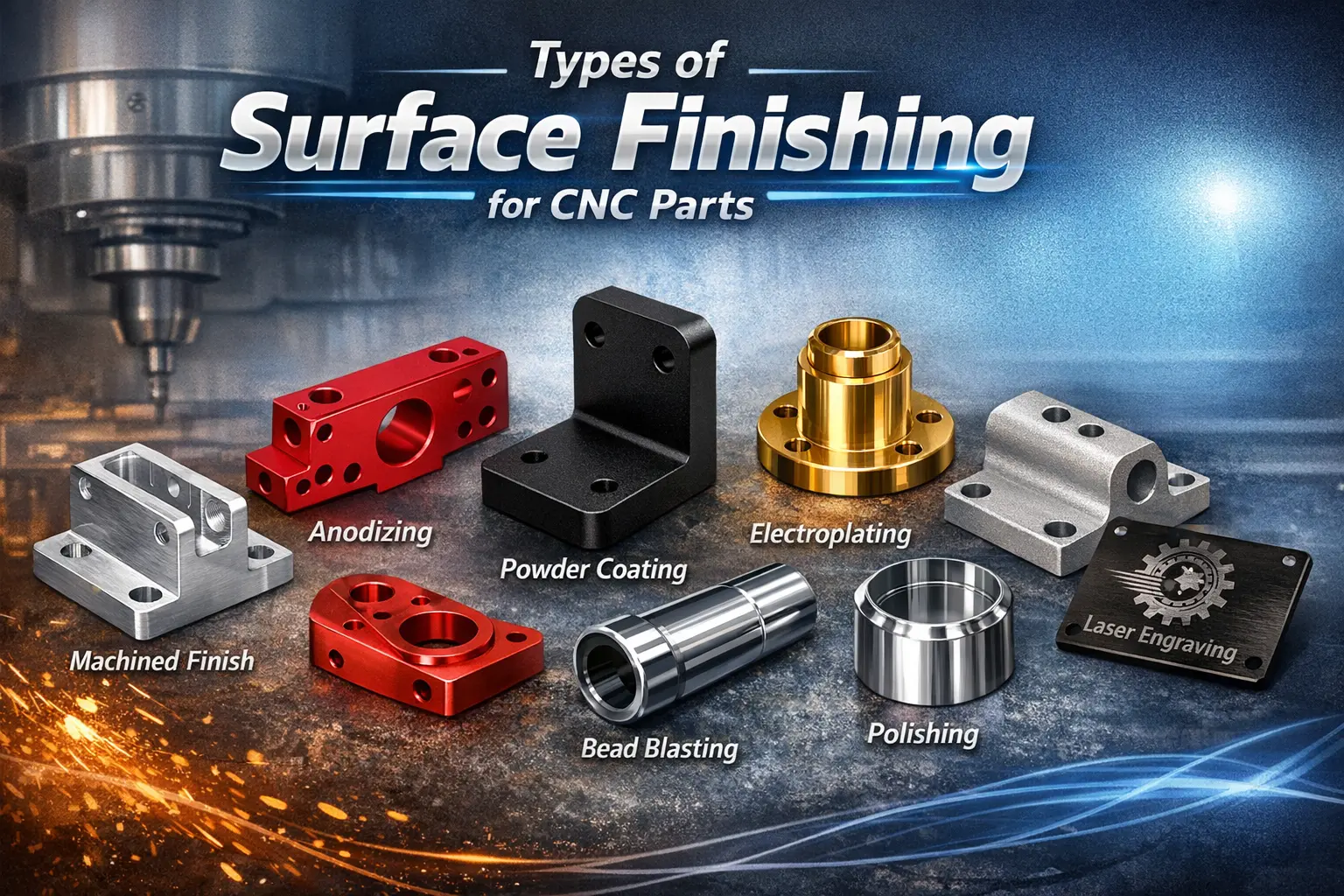
Surface finishing refers to a range of post-processing techniques applied to CNC machined parts to improve their surface quality, functionality, and appearance. After a part is manufactured through CNC machining, it often retains visible tool marks, sharp edges, or minor surface irregularities. Surface finishing processes are used to refine these characteristics, ensuring the final part meets both aesthetic and functional requirements.
Surface finishing can involve mechanical, chemical, or coating-based methods depending on the material and intended application. For example, aluminum parts may undergo anodizing to enhance corrosion resistance and add color, while stainless steel components might be passivated to improve their resistance to oxidation. In other cases, polishing or grinding may be used to achieve a smoother surface or tighter tolerances.
Beyond appearance, surface finishing plays a critical role in defining how a part performs in real-world conditions. It can influence friction, wear resistance, electrical conductivity, and even how a part interacts with other components in an assembly. This makes surface finishing an essential step in industries such as automotive, aerospace, medical devices, and consumer electronics.
Surface finishing is not just a cosmetic enhancement—it is a vital aspect of manufacturing that directly impacts product performance and longevity. One of the primary benefits is improved durability. By applying protective coatings or treatments, parts become more resistant to wear, corrosion, and environmental damage. For instance, electroplated or powder-coated components can withstand harsh operating conditions far better than untreated surfaces.
Another key advantage is enhanced aesthetics. In many industries, especially consumer-facing ones, the visual quality of a product is just as important as its functionality. Surface finishing allows manufacturers to achieve specific textures, colors, and finishes that align with branding and design requirements. Whether it is a matte black finish or a high-gloss polished surface, finishing processes help create a professional and appealing look.
Surface finishing also contributes to better performance by reducing friction and improving surface smoothness. This is particularly important in moving parts, where lower friction can lead to increased efficiency and reduced wear over time. Additionally, certain finishing techniques can improve adhesion for paints, coatings, or bonding processes, ensuring better integration in complex assemblies.
Finally, surface finishing helps ensure compliance with industry standards and specifications. Many applications require specific surface roughness levels or protective treatments to meet regulatory or safety requirements. Without proper finishing, even a precisely machined part may fail to meet these standards, leading to performance issues or product rejection.
Mechanical finishing methods are among the most widely used techniques for improving the surface quality of CNC parts. These processes physically alter the surface through abrasion or mechanical action. Common methods include sanding, grinding, and polishing, each offering different levels of surface refinement. Sanding is typically used to remove tool marks and achieve a uniform texture, while grinding can provide tighter dimensional accuracy. Polishing, on the other hand, is used to achieve a smooth or mirror-like finish, often required in high-end or precision applications.
Deburring is another essential mechanical process that removes sharp edges and burrs left behind after machining. This not only improves safety during handling but also ensures proper assembly and functionality. Vibratory finishing is often used for batch processing of small parts, where components are placed in a vibrating container with abrasive media to achieve consistent surface smoothing.
Chemical finishing involves the use of chemical reactions to modify the surface properties of CNC parts. One of the most common methods is anodizing, particularly for aluminum components. This process creates a protective oxide layer that enhances corrosion resistance and allows for color customization. Passivation is another widely used technique, especially for stainless steel, where it removes free iron from the surface and improves corrosion resistance.
Chemical etching and electrochemical polishing are also important processes in this category. Chemical etching is used to selectively remove material and create specific surface patterns or textures. Electrochemical polishing, often referred to as electropolishing, smooths and brightens metal surfaces by removing a thin layer of material through an electrochemical process. This results in improved cleanliness, reduced surface roughness, and enhanced corrosion resistance.
Coating and plating methods involve applying a layer of material onto the surface of a CNC part to enhance its properties. Electroplating is a widely used technique where a thin metal layer, such as nickel, chrome, or zinc, is deposited onto the part. This improves corrosion resistance, wear resistance, and appearance.
Powder coating is another popular option, especially for parts requiring a durable and visually appealing finish. It involves applying a dry powder that is then cured under heat to form a hard, protective layer. Black oxide and zinc coatings are commonly used for steel parts to provide corrosion protection and a uniform appearance.
Advanced surface finishing methods are increasingly used in high-performance and specialized applications. Physical Vapor Deposition (PVD) and Chemical Vapor Deposition (CVD) are coating techniques that create extremely thin, hard layers with excellent wear resistance and durability. These are often used in cutting tools and aerospace components.
Laser surface texturing is another advanced method that uses laser technology to create precise surface patterns, improving properties such as friction control and fluid retention. Nano-coatings, which involve applying ultra-thin layers at the nanoscale, are also gaining popularity for their ability to provide superior protection without significantly altering part dimensions.
Selecting the right surface finishing process begins with understanding the material of the CNC part. Different materials respond differently to various finishing techniques. For example, aluminum is highly suitable for anodizing, which enhances both its corrosion resistance and aesthetic appeal. Stainless steel benefits from passivation or electropolishing, which improve its resistance to oxidation and create a cleaner surface. Plastics, on the other hand, may require polishing or specialized coatings to achieve the desired finish without damaging the material.
Functionality is another critical factor in choosing a surface finishing method. If a part is exposed to harsh environments, corrosion resistance becomes a top priority, making coatings like anodizing, electroplating, or powder coating ideal choices. For parts subject to friction and wear, such as moving components, polishing or advanced coatings like PVD can significantly improve performance. In electrical applications, certain finishes may be required to enhance conductivity or insulation.
Aesthetic requirements also play a significant role in the decision-making process. Surface finishing can dramatically alter the look and feel of a part, from matte and satin finishes to high-gloss or colored coatings. For consumer products, achieving a visually appealing finish is often just as important as functionality. Anodizing allows for a wide range of colors, while polishing can create a premium, reflective surface. Powder coating offers both durability and customization in terms of color and texture.
Cost and lead time are practical factors that must be considered when selecting a surface finishing process. Some methods, such as basic sanding or deburring, are relatively inexpensive and quick to implement. Others, like PVD coatings or electropolishing, may require specialized equipment and longer processing times, resulting in higher costs. It is important to balance performance requirements with budget and production timelines.
In many cases, working with an experienced manufacturing partner can help optimize this balance. By evaluating the part’s material, application, and design requirements, manufacturers can recommend the most cost-effective finishing solution without compromising quality. Choosing the right surface finishing ultimately ensures that CNC parts not only meet technical specifications but also perform reliably in their intended applications.
One of the most significant challenges in surface finishing for CNC parts is dealing with complex geometries and hard-to-reach features. Modern CNC machining enables the production of highly intricate components with deep cavities, narrow channels, undercuts, and detailed internal structures. While these features are essential for functionality, they create difficulties during the finishing stage. Standard finishing tools such as polishing wheels, brushes, or spray coatings may not effectively reach these confined areas, resulting in uneven surface quality. Inconsistent finishing can negatively impact both the appearance and performance of the part. To overcome this, manufacturers often need to use specialized techniques such as micro-finishing tools, custom fixtures, or advanced methods like electropolishing or vibratory finishing. However, these solutions can increase complexity and cost, making process planning more critical.
Another major challenge lies in preserving tight tolerances and dimensional accuracy after surface finishing. Many finishing processes involve either material removal, such as grinding and polishing, or material addition, such as coating, anodizing, or electroplating. Even a slight variation in thickness can affect how a part fits or functions within an assembly. This is especially critical for high-precision industries where even microns of deviation can lead to performance issues or part rejection. Engineers must account for these changes during the design phase by incorporating appropriate allowances. In addition, process control must be highly precise to ensure that finishing does not compromise the integrity of the part. Achieving this balance requires both technical expertise and advanced inspection methods.
Material compatibility is another key challenge in surface finishing. Different materials respond differently to finishing processes, and selecting the wrong method can lead to suboptimal results or even damage. For example, certain chemical treatments may cause discoloration or corrosion if applied to incompatible alloys, while some coatings may fail to adhere properly without adequate surface preparation. Plastics and softer materials can be particularly sensitive to heat or chemical exposure, requiring careful selection of finishing techniques. This makes it essential to have a deep understanding of material properties and how they interact with various finishing processes. Proper testing and validation are often necessary to ensure that the chosen method delivers the desired outcome.
Ensuring consistency and repeatability in surface finishing is especially challenging in large-scale production. Variations in temperature, chemical composition, processing time, or operator technique can lead to differences in surface quality between batches. Maintaining strict quality control measures is essential to achieving uniform results. This often involves implementing standardized procedures, automated systems, and thorough inspection protocols. Additionally, environmental and safety considerations add another layer of complexity. Many surface finishing processes involve hazardous chemicals or emissions that must be carefully managed to comply with regulations. Proper waste disposal, ventilation systems, and worker safety measures are critical, but they also increase operational costs. Balancing quality, compliance, and efficiency remains an ongoing challenge for manufacturers.
WeYoung CNC offers a strong advantage through its ability to combine CNC machining and surface finishing into a seamless, integrated process. This integration significantly reduces lead times and eliminates the need for multiple suppliers. For businesses that rely on rapid prototyping or tight production schedules, fast turnaround is essential. WeYoung CNC is structured to handle both small-batch prototypes and large-scale production efficiently, ensuring that customers receive high-quality finished parts without unnecessary delays. By streamlining the workflow from machining to finishing, the company minimizes logistical challenges and improves overall project efficiency.
Another key benefit of working with WeYoung CNC is the wide variety of surface finishing options available. Different applications require different finishing solutions, and having access to multiple processes under one roof simplifies decision-making and execution. Whether the requirement is anodizing for aluminum parts, electroplating for enhanced corrosion resistance, powder coating for durability and aesthetics, or precision polishing for a smooth surface, WeYoung CNC can provide tailored solutions. This versatility ensures that each part receives the most appropriate treatment based on its material, function, and design requirements.
Quality is a critical factor in surface finishing, and WeYoung CNC places a strong emphasis on maintaining high standards throughout the process. Each stage of finishing is carefully monitored to ensure consistency, accuracy, and compliance with specifications. This includes checking surface roughness, coating thickness, adhesion, and overall appearance. Advanced inspection tools and experienced technicians work together to identify and address any potential issues before the final product is delivered. This commitment to quality helps ensure that finished parts not only meet but exceed customer expectations.
WeYoung CNC also stands out for its customer-focused approach. Surface finishing is not a one-size-fits-all process, and selecting the right method requires careful evaluation of multiple factors. The team works closely with clients to understand their specific needs, including performance requirements, aesthetic preferences, budget constraints, and production timelines. Based on this information, they provide expert recommendations to help customers make informed decisions. This collaborative approach ensures that each project achieves the best possible balance between quality, cost, and efficiency.
Surface finishing is an essential component of CNC manufacturing that significantly enhances the performance, durability, and appearance of machined parts. From addressing surface imperfections to improving resistance against corrosion and wear, finishing processes play a vital role in ensuring that parts meet both functional and aesthetic requirements. However, achieving the desired results is not without challenges. Factors such as complex geometries, tight tolerances, material compatibility, and the need for consistent quality all contribute to the complexity of surface finishing. Additionally, environmental and safety considerations must be managed carefully to ensure compliance with industry standards.
Selecting the right manufacturing partner can make a substantial difference in overcoming these challenges. An experienced provider not only offers technical expertise but also ensures that the finishing process is aligned with the specific needs of each project. By leveraging advanced equipment, strict quality control systems, and a wide range of finishing options, manufacturers can deliver high-quality results that meet demanding specifications. A reliable partner also helps streamline production, reduce lead times, and optimize costs, making the entire process more efficient and predictable.
In today’s competitive manufacturing environment, surface finishing should not be viewed as an optional step but as a critical factor in product success. Properly finished parts perform better, last longer, and present a more professional appearance. Whether for prototyping or mass production, investing in the right finishing techniques and working with a capable partner ensures that CNC parts achieve their full potential. By carefully considering all relevant factors and adopting a strategic approach, businesses can enhance product quality, improve customer satisfaction, and gain a competitive edge in the market.
