Address
304 North Cardinal St.
Dorchester Center, MA 02124
Work Hours
Monday to Friday: 7AM - 7PM
Weekend: 10AM - 5PM

Address
304 North Cardinal St.
Dorchester Center, MA 02124
Work Hours
Monday to Friday: 7AM - 7PM
Weekend: 10AM - 5PM
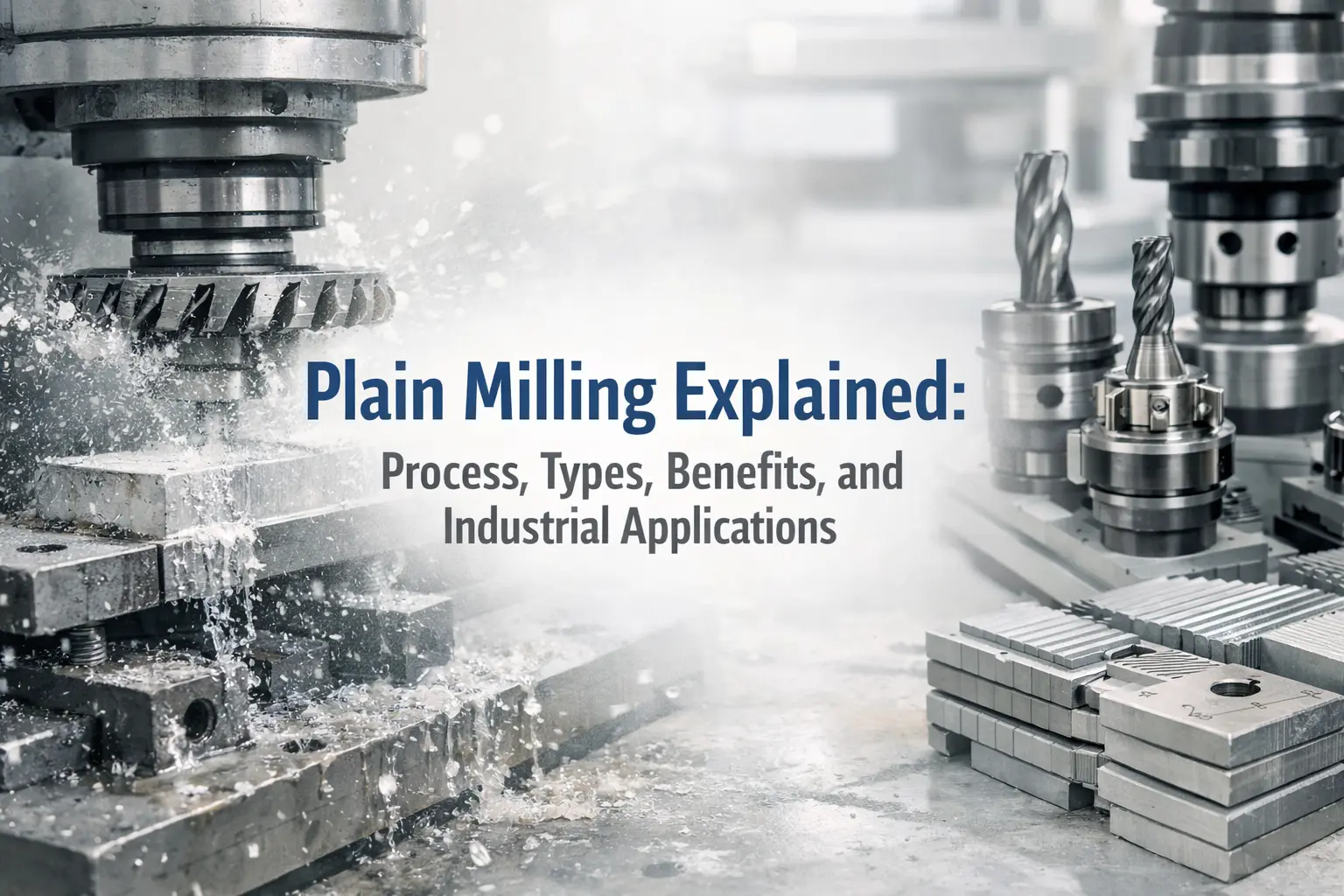
Plain milling, also known as slab milling, is one of the most fundamental and widely used milling processes in CNC machining. Its primary purpose is to remove material from the surface of a workpiece using a rotating cutter whose axis is parallel to the surface being machined. Unlike more complex milling operations that follow intricate profiles, plain milling focuses on producing flat, even surfaces efficiently. The cutter’s side teeth engage with the workpiece, allowing for a high material removal rate, which makes it ideal for preparing large metal slabs or base surfaces for subsequent operations.
The significance of plain milling goes beyond simple material removal. It often serves as the foundation for further high-precision machining. For example, in aerospace manufacturing, structural components require perfectly flat reference surfaces to ensure dimensional accuracy in downstream operations. Similarly, in machinery manufacturing, achieving precise flatness in bases, rails, or mounting surfaces is critical for assembly accuracy and machine stability. Without this initial flat surface, advanced CNC operations such as form milling—covered in our guide to form milling—would not achieve their full precision potential.
From a cost perspective, plain milling is also highly advantageous. Standard slab milling cutters are widely available and relatively inexpensive, while the process itself allows for fast material removal. This efficiency reduces cycle times, lowers per-part costs, and can easily be integrated into automated CNC production workflows. With modern CNC machines capable of running unattended operations, plain milling supports high-volume manufacturing while maintaining consistent quality.
Another key benefit is its role in enabling subsequent machining processes. Many specialized milling operations, such as side milling and form milling, rely on having stable, flat reference surfaces to ensure precision. By creating a high-quality base plane, plain milling establishes the critical geometry needed for accurate, repeatable cuts later in the manufacturing process.
Understanding the plain milling process, its parameters, and its role in the overall manufacturing workflow is essential for engineers and manufacturers. It is not merely an isolated operation—it is a foundational step that affects efficiency, surface quality, and the success of downstream machining processes.
Although plain milling may seem straightforward, it requires careful planning and control to achieve high efficiency and excellent surface quality. The process generally consists of preparation, setup, cutting execution, and inspection stages, all of which must be managed correctly to optimize results.
The first step is securing the workpiece firmly on the milling machine table. Clamps, angle plates, or custom fixtures are commonly used to prevent movement during cutting. Proper fixturing is crucial not only for quality but also for operator safety, as any slippage during milling could result in surface defects or accidents. A stable setup ensures that the cutter maintains consistent engagement with the material, which is particularly important for achieving uniform flatness.
Tool selection is equally critical. Plain milling typically uses cylindrical cutters, with teeth along the periphery to perform the cutting. Depending on the material and desired finish, either roughing or finishing cutters may be chosen. Roughing cutters have larger, widely spaced teeth and are ideal for rapid material removal, while finishing cutters provide finer teeth for achieving higher surface quality.
Optimizing milling parameters is essential for efficiency and tool longevity. Key parameters include:
Correctly setting these parameters minimizes vibration, reduces tool wear, and enhances surface quality. Engineers often adjust these values based on material type, machine rigidity, and required finish.
Once setup is complete, the CNC program initiates the cutting process. During milling, operators must monitor chip evacuation, coolant application, and vibration levels. For high-volume operations, automated tool changers can switch between roughing and finishing cutters to maximize productivity. Throughout the process, maintaining stability ensures consistent flatness and repeatable results.
After cutting, precision inspection is required to verify that the surface meets design specifications. Tools such as coordinate measuring machines (CMMs) or surface flatness gauges assess quality. In high-precision applications, additional finishing steps such as grinding or polishing may be employed to achieve the desired surface finish. Properly executed, plain milling produces flat surfaces that serve as the foundation for subsequent operations, including advanced processes like form milling, which rely on this initial flatness for precision.
Plain milling is not a single, one-size-fits-all process. It can be categorized based on cutter direction, material removal requirements, and desired surface finish. Understanding these types allows engineers to select the right method for each application.
In conventional milling, the cutter rotates against the direction of the workpiece feed. The chip thickness starts at zero and increases gradually as the cut progresses. This approach is safer for workpieces with less rigid fixturing because the cutter tends to push the material downward, reducing the chance of pullout. However, friction is higher due to increasing chip thickness, which can lead to greater tool wear and heat generation, potentially impacting surface finish quality. Conventional milling is often used for roughing operations where maximum material removal is more important than surface finish.
Climb milling moves the cutter in the same direction as the workpiece feed. The chip thickness starts at its maximum and decreases toward the end of the cut, resulting in lower cutting forces and smoother surface finishes. Modern CNC machines with backlash-free drive systems handle climb milling very effectively. However, because the cutter can pull the workpiece, fixturing must be very secure to avoid movement. Climb milling is preferred for finishing operations, particularly on hardened metals or components requiring precise surface flatness.
Plain milling can also be categorized by cutter geometry. Heavy-duty roughing cutters have fewer teeth and larger spacing to rapidly remove material, while fine-tooth finishing cutters provide smooth, precise surfaces. Selecting the appropriate cutter is critical for balancing material removal rates, surface finish, and tool life. Integrating these cutters into modern CNC workflows allows manufacturers to efficiently combine roughing and finishing in a single setup.
The choice of plain milling type depends on several factors, including machine rigidity, workpiece material, desired surface finish, and production volume. Understanding these distinctions ensures optimal efficiency, accuracy, and cost-effectiveness in milling operations.
Plain milling is a versatile machining process that can accommodate a wide range of materials. Selecting the appropriate material and understanding how it interacts with the cutter is crucial for achieving high-quality results, optimizing efficiency, and extending tool life.
The most common materials for plain milling are metals, including steel, aluminum, brass, and copper. Steel is widely used in industrial applications due to its strength and durability, but it requires proper coolant application and carefully chosen cutting parameters to avoid excessive tool wear and heat generation. High-carbon or alloy steels, often used for automotive or aerospace components, benefit from climb milling during finishing to achieve superior surface quality.
Aluminum is another favorite for plain milling because it is relatively soft, lightweight, and easy to machine. It allows for faster feed rates and higher spindle speeds, making it suitable for both roughing and finishing operations. Aluminum’s low hardness also reduces tool wear, which is ideal for high-volume production.
Brass and copper are commonly machined for plumbing, decorative components, and electrical parts. Their lower melting points and ductility require careful chip evacuation and controlled cutting parameters to prevent material smearing or workpiece deformation.
Plain milling is not limited to metals. Engineering plastics, such as Delrin, PEEK, and nylon, can also be milled efficiently. These materials are increasingly used in automotive, medical, and electronics applications due to their lightweight and corrosion-resistant properties. When milling plastics, lower cutting speeds and moderate feed rates are essential to avoid melting, chipping, or excessive surface friction.
Composite materials, including carbon-fiber-reinforced polymers (CFRP), can also be processed using plain milling. However, composites demand specialized cutters designed to minimize delamination and fiber pullout. Proper cooling and dust management are critical in maintaining both tool life and workpiece integrity.
The choice of material affects cutter selection, feed rates, and depth of cut. Roughing cutters with coarse teeth are suitable for large, tough metals, while fine-tooth finishing cutters are preferred for softer metals, plastics, or components requiring tight tolerances. Regardless of the material, creating a flat and stable surface with plain milling is often the first step before performing more complex processes like form milling, ensuring downstream operations achieve precision and repeatability.
Plain milling offers numerous benefits that make it a preferred method for producing flat surfaces across industries. Its combination of efficiency, precision, and versatility has kept it a staple in modern CNC machining.
One of the most significant advantages of plain milling is its ability to remove large volumes of material quickly. The cutter engages with the workpiece across its side teeth, which allows for broad contact and higher cutting rates compared to end milling. This makes plain milling ideal for roughing operations where large amounts of material need to be removed before finishing.
Plain milling is highly cost-efficient. Standard slab milling cutters are inexpensive and durable, and the process itself is relatively fast, reducing machine time and labor costs. When combined with automated CNC machines, plain milling supports high-volume production runs while minimizing waste and rework. This makes it particularly attractive for manufacturers seeking both speed and economy.
Plain milling is adaptable to a wide range of materials—from metals like steel, aluminum, and brass to plastics and composites. This versatility allows manufacturers to standardize operations and tooling across different projects, simplifying production planning and inventory management.
Despite being primarily a roughing operation, plain milling can achieve very flat surfaces with proper setup and tool selection. With climb milling and finishing passes, the process can produce excellent surface finishes suitable for critical applications. A high-quality flat surface from plain milling also ensures the accuracy of secondary operations such as drilling, side milling, or form milling.
Modern CNC machines enhance the benefits of plain milling through precise control, automatic tool changers, and programmable feed strategies. This integration allows for fully automated roughing and finishing cycles, reducing human error and improving repeatability for large production runs.
While plain milling is highly effective, it has inherent limitations that engineers must consider when planning machining operations.
Plain milling is designed for flat surfaces. It is not suitable for machining complex contours, intricate profiles, or highly curved surfaces. For such geometries, processes like form milling or 3D contour milling are required.
The process relies heavily on machine rigidity and secure fixturing. Any movement or vibration can negatively affect surface finish and flatness. High-precision applications require stable CNC machines and robust workholding solutions to maintain dimensional accuracy.
Because plain milling engages a broad surface area, tool wear can be significant, especially when cutting harder metals. Regular inspection, sharpening, or replacement of cutters is necessary to maintain efficiency and quality. Improper tool maintenance may lead to surface defects, increased cutting forces, or premature tool failure.
Continuous cutting over large surfaces can generate heat, which may affect the workpiece or reduce tool life. Proper coolant application and parameter optimization are critical to mitigating these effects.
Understanding these limitations allows manufacturers to plan operations effectively, combining plain milling with complementary processes to achieve the desired results efficiently.
Plain milling is widely used across various industries due to its efficiency, cost-effectiveness, and versatility. Its applications range from roughing large metal plates to preparing surfaces for precision machining.
In automotive manufacturing, plain milling is used to machine engine blocks, transmission housings, and structural components. Flat, precise surfaces are crucial for assembly and performance, making plain milling an essential step in the production workflow.
Aerospace components demand extremely high precision. Plain milling is employed to produce flat reference surfaces on aircraft frames, landing gear components, and structural supports. These surfaces ensure subsequent operations, including form milling, are accurate and reliable.
Plain milling is used to machine base plates, guide rails, and mounting surfaces for heavy machinery. The process guarantees flatness and surface integrity, which are critical for mechanical stability and long-term performance.
In prototyping and low-volume production, plain milling provides fast and cost-effective surface preparation. It enables engineers to produce flat surfaces quickly, supporting small-batch production, custom parts, and iterative prototyping workflows. This makes it ideal for rapid manufacturing applications where precision and speed are both priorities.
Plain milling is just one of several milling processes used in CNC machining. Understanding the differences between plain milling and other milling operations is essential for engineers and manufacturers to select the right method for their application.
The primary difference between plain milling and face milling lies in the orientation of the cutter relative to the workpiece. In plain milling, the cutter’s axis is parallel to the surface being machined, and the side teeth of the cutter remove material. In contrast, face milling uses cutters with their axes perpendicular to the surface, and the cutting occurs mainly at the face of the tool.
Face milling is particularly effective for producing very flat surfaces over large areas and can achieve higher surface quality in a single pass. However, plain milling is more suitable when the goal is to remove large volumes of material quickly and create a rough or semi-finished flat surface. Engineers often use plain milling for roughing and then follow with face milling or form milling to achieve final precision.
End milling involves cutters with teeth on the end and periphery of the tool, allowing them to create slots, pockets, and intricate profiles. While plain milling is optimized for flat surfaces, end milling can produce complex geometries that plain milling cannot handle. End mills are often used for finishing, contouring, or profile milling, whereas plain milling remains the preferred method for large-scale flat surface roughing.
Side milling, a process covered in our form milling guide, uses the sides of the cutter to remove material along the workpiece’s sidewalls. While side milling is excellent for cutting grooves, slots, and profiles, plain milling is designed to handle extensive flat surfaces. Manufacturers often combine plain milling with side or form milling to create complex parts efficiently.
The choice between plain milling and other milling methods depends on several factors: material type, surface finish requirements, part geometry, and production volume. For instance, a large flat base for an industrial machine may first undergo plain milling for roughing, followed by face milling for finishing and then side or form milling for detailed features. Understanding these distinctions helps manufacturers optimize productivity, maintain quality, and minimize costs.
Designing parts for plain milling requires careful attention to workpiece geometry, tolerances, and machining parameters. Proper design ensures manufacturability, improves efficiency, and reduces post-processing needs.
Since plain milling primarily produces flat surfaces, designers should ensure that the areas intended for milling are accessible by the cutter. Overhangs, deep recesses, or obstructed areas may require alternative milling processes, such as form milling, to complete. Reference surfaces created by plain milling often serve as the basis for form milling or side milling, so accessibility is critical for both roughing and finishing stages.
Flatness and parallelism are key considerations in plain milling. Specifying appropriate tolerances helps the machinist select the correct cutter type, feed rate, and depth of cut. Excessively tight tolerances may increase tool wear or require additional finishing passes, while loose tolerances could compromise the accuracy of subsequent machining operations.
Surface finish is equally important. For parts that will undergo secondary operations, such as drilling, form milling, or assembly, a moderately smooth surface from plain milling is often sufficient. For precision applications, finishing passes with finer cutters can enhance surface quality.
Designers must consider the material of the workpiece in relation to cutter selection. Harder metals like alloy steel require cutters with high wear resistance and may benefit from climb milling, while softer materials like aluminum or brass allow faster feed rates. Incorporating the right cutter into the design stage can significantly improve efficiency and reduce costs.
Good design practices can minimize potential machining issues. Avoiding excessively long flat surfaces without intermediate supports reduces vibration, while including pockets or features for fixture access ensures stable clamping. Additionally, planning for chip evacuation and coolant flow can prevent overheating or material smearing, which is especially important for plastics and composites.
By carefully considering geometry, material, tolerances, and fixture requirements, designers can maximize the benefits of plain milling and create a solid foundation for subsequent operations like form milling.
Selecting a reliable milling service provider is crucial for achieving high-quality results, meeting production deadlines, and optimizing costs. Here are key factors manufacturers should evaluate:
A service provider must have the right milling equipment for the job. CNC milling machines with sufficient rigidity, precision, and tooling options are essential for flatness and repeatability. Some providers also offer multi-axis machines capable of combining plain milling with side or form milling in a single setup.
Different materials require specific cutting strategies. A reputable provider should demonstrate experience with metals, plastics, and composites. They should also advise on cutter selection, feed rates, and cooling methods to optimize efficiency while preserving surface quality.
High-quality plain milling depends on proper inspection and verification. Service providers should use tools such as coordinate measuring machines (CMMs), flatness gauges, and surface roughness meters to ensure accuracy. Providers with ISO-certified quality systems or robust in-house QA processes are preferable.
Efficiency is key for manufacturers. Choose a provider who can balance competitive pricing with quick turnaround times without compromising quality. Some providers, like WeYoung CNC, specialize in rapid manufacturing and short lead times, making them ideal for both prototyping and low-volume production.
Reviewing a provider’s experience with similar projects can indicate their capability to handle your requirements. Case studies or past projects demonstrating successful plain milling for automotive, aerospace, or industrial equipment provide confidence in their expertise. Providers who integrate plain milling with complementary processes such as form milling offer added value.
Choosing the right service partner ensures not only precise milling but also smooth integration into your production workflow, supporting efficiency, cost-effectiveness, and high-quality outcomes.
When selecting a manufacturing partner for plain milling, quality, speed, and versatility are paramount. WeYoung CNC stands out as a leading provider due to its comprehensive capabilities and customer-focused approach.
WeYoung CNC specializes in rapid manufacturing, offering short lead times for both prototyping and low-volume production. This is particularly valuable for industries like aerospace, automotive, and industrial machinery, where timing can impact project schedules. By leveraging advanced CNC equipment, WeYoung CNC can execute high-volume plain milling projects efficiently while maintaining precision and quality.
One of WeYoung CNC’s strengths is its experience across metals, plastics, and composites. From aluminum and steel to engineering plastics like PEEK or nylon, the team knows how to optimize cutting parameters for each material. This ensures minimal tool wear, high surface quality, and consistent results. The expertise also allows seamless integration of processes like form milling and side milling, providing complete part solutions under one roof.
WeYoung CNC uses high-precision CNC milling machines, including multi-axis capabilities for complex part geometries. The facility is equipped with state-of-the-art cutters, fixtures, and automation tools that enhance machining efficiency and consistency. This ensures that even demanding plain milling tasks, such as producing large flat surfaces for industrial bases or structural components, are completed accurately and reliably.
Quality is at the heart of every project at WeYoung CNC. The company employs comprehensive inspection systems, including coordinate measuring machines (CMMs) and surface roughness gauges, to verify flatness, tolerances, and overall surface quality. These measures guarantee that parts are production-ready and meet the strict standards required in sectors like aerospace and automotive.
Beyond equipment, WeYoung CNC offers technical consultation, helping clients select the best milling processes, tools, and materials. Their engineers advise on design optimization for plain milling, ensuring that parts are not only manufacturable but also cost-effective. For projects that require subsequent processes such as form milling, WeYoung CNC provides seamless workflow integration, reducing time and errors.
In short, choosing WeYoung CNC ensures high-quality plain milling, faster lead times, and the confidence that your parts will meet both design and functional requirements.
Plain milling is a fundamental but powerful process in CNC machining, offering a combination of efficiency, versatility, and precision. Its ability to create flat, stable surfaces quickly makes it ideal for roughing operations and as a preparatory step for complex milling techniques like side milling or form milling.
The advantages of plain milling are numerous: it allows rapid material removal, cost-effective production, adaptability across a wide range of materials, and excellent surface quality. However, to maximize these benefits, careful attention must be paid to design, tooling, fixturing, and machine parameters. Understanding limitations, such as its restriction to flat surfaces and the need for rigid setups, ensures that plain milling is applied optimally.
By combining plain milling with complementary processes, manufacturers can produce parts efficiently without compromising precision. Selecting the right service provider, like WeYoung CNC, guarantees access to advanced equipment, material expertise, and rigorous quality control, all of which are critical to achieving superior results.
Ultimately, plain milling is more than just a machining step—it is a strategic tool that enables higher accuracy, cost savings, and faster production cycles. Whether for prototyping, low-volume production, or large-scale manufacturing, leveraging plain milling effectively ensures that your parts meet the highest standards while reducing time and cost.
Q1: What is the difference between plain milling and face milling?
Plain milling uses a cutter parallel to the surface with side teeth removing material, ideal for flat surfaces. Face milling uses a perpendicular cutter, removing material mainly with the face of the tool and often producing higher surface finish in a single pass. For large flat areas, plain milling is typically used for roughing before finishing.
Q2: Which materials are suitable for plain milling?
Plain milling can handle metals (steel, aluminum, brass, copper), plastics (PEEK, nylon, Delrin), and certain composites. Cutter selection, feed rates, and coolant strategies are adjusted depending on the material to optimize efficiency and surface quality.
Q3: Is plain milling suitable for high-precision parts?
Yes, when combined with proper fixturing, cutting parameters, and finishing passes, plain milling can achieve high flatness and serve as a stable reference for further precision operations, including form milling.
Q4: When should I use climb milling vs conventional milling?
Climb milling (down milling) is preferred for finishing and achieving smooth surfaces, especially with rigid CNC machines. Conventional milling (up milling) is safer for roughing on less rigid setups, reducing the risk of workpiece pullout.
Q5: How do I choose the right plain milling service provider?
Key considerations include machine capability, multi-material expertise, quality control systems, experience with similar projects, and ability to integrate complementary processes such as form or side milling. Providers like WeYoung CNC excel in these areas, offering rapid, high-precision, and reliable milling solutions.
