Address
304 North Cardinal St.
Dorchester Center, MA 02124
Work Hours
Monday to Friday: 7AM - 7PM
Weekend: 10AM - 5PM

Address
304 North Cardinal St.
Dorchester Center, MA 02124
Work Hours
Monday to Friday: 7AM - 7PM
Weekend: 10AM - 5PM
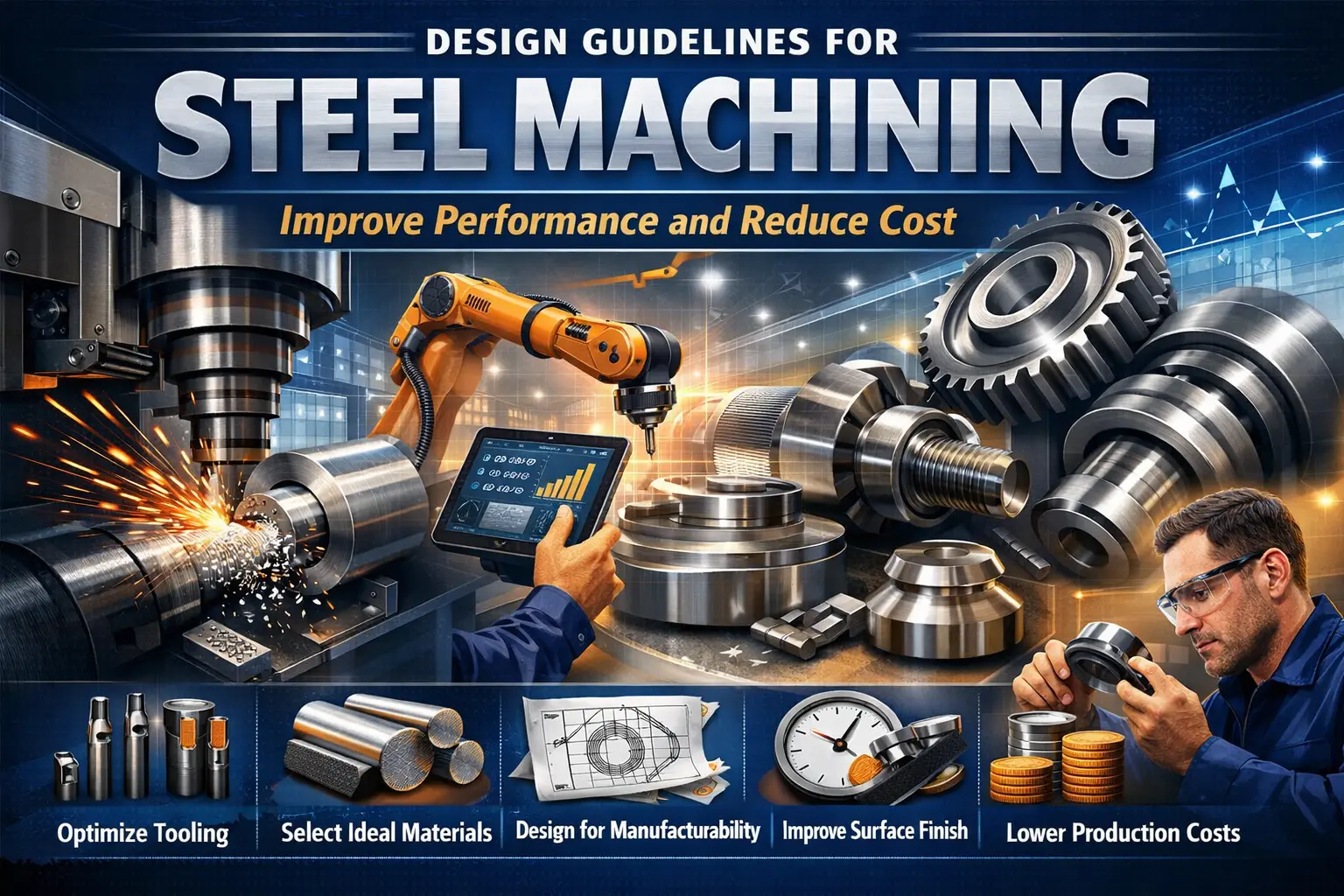
Steel machining plays a critical role across industries such as automotive, aerospace, construction, and industrial equipment due to steel’s exceptional strength, durability, and versatility. However, these same properties that make steel desirable also introduce challenges in manufacturing, including higher tool wear, longer machining times, and increased production costs. Without thoughtful design, steel components can quickly become expensive and time-consuming to produce, especially in low-volume or precision applications.
Design for manufacturability (DFM) is essential when working with steel. By considering machining constraints early in the design phase, engineers can significantly reduce costs while maintaining or even improving part performance. Smart design decisions—such as selecting the right material grade, simplifying geometries, and optimizing tolerances—can streamline production, minimize waste, and shorten lead times.
Another important factor is collaboration with experienced manufacturing partners. Early communication with a supplier allows designers to align their concepts with real-world machining capabilities, preventing costly redesigns later. If you are planning a steel machining project, it is always beneficial to consult experts who can provide feedback on feasibility and cost optimization. You can reach out for professional support here: https://weyoungcnc.com/contact/.
This article explores key design guidelines that help improve machining efficiency and reduce overall production costs, starting with a deeper understanding of steel properties and their direct impact on machining processes.
Steel comes in a wide range of grades, each with distinct mechanical properties such as hardness, tensile strength, ductility, and toughness. These properties directly influence machining behavior. For example, high-carbon and alloy steels tend to be harder and stronger, which improves wear resistance but makes them more difficult to cut. This often results in increased tool wear and slower machining speeds. On the other hand, low-carbon steels are softer and more ductile, making them easier to machine but less suitable for high-strength applications.
Thermal conductivity is another important factor. Materials with lower thermal conductivity tend to retain heat during machining, which can accelerate tool degradation and affect surface quality. Understanding these mechanical and thermal characteristics allows designers to anticipate machining challenges and make informed decisions early in the design phase.
Machinability refers to how easily a material can be cut while achieving acceptable surface finish, tool life, and machining efficiency. Some steels, such as free-machining grades, are specifically engineered to improve machinability by adding elements like sulfur. These additives reduce friction and improve chip formation, allowing for faster cutting speeds and lower tooling costs.
Poor machinability can lead to increased cycle times, frequent tool replacement, and inconsistent part quality. Designers should consider machinability ratings when selecting materials, especially for complex parts or high-volume production. Choosing a steel grade with better machinability can significantly reduce overall manufacturing costs without compromising functionality.
Steel properties also determine the type of cutting tools, coatings, and machining strategies required. Harder steels may require carbide or coated tools, as well as optimized cutting parameters to maintain efficiency. In some cases, multi-step machining or specialized processes may be necessary.
By understanding how steel properties influence machining, designers can create parts that align better with manufacturing capabilities. This not only improves production efficiency but also helps avoid unexpected delays and costs. For tailored advice on optimizing your steel part design, consider consulting a professional machining provider: https://weyoungcnc.com/contact/.
Selecting the appropriate steel grade is one of the most important decisions in part design. While it may be tempting to choose the strongest or most durable material available, this often leads to unnecessary costs and machining complexity. Instead, designers should match material properties closely to the actual performance requirements of the part.
For example, low-carbon steels like 1018 offer excellent machinability and are suitable for many general-purpose applications. Medium-carbon steels such as 1045 provide a balance between strength and machinability, while alloy steels like 4140 offer higher strength and toughness for demanding environments. By carefully evaluating the functional needs of the component, designers can avoid over-specification and reduce material and machining expenses.
Material cost is not limited to the raw price of steel. Availability, lead time, and supply chain considerations also play a significant role. Standard, widely available grades are typically more cost-effective and easier to source, reducing both procurement delays and overall project costs.
Custom or specialty materials may be necessary in some cases, but they should only be used when absolutely required. Designers should also consider the form in which the material is available, such as bar stock, plate, or pre-shaped blanks, as this can impact machining efficiency and waste.
Over-specification is a common mistake in engineering design. Specifying tighter mechanical properties or higher-grade materials than necessary can significantly increase costs without delivering meaningful benefits. This is particularly important in steel machining, where harder materials often require more advanced tooling and longer machining times.
A practical approach is to define clear performance criteria and select the most cost-effective material that meets those requirements. Collaborating with machining experts can help identify alternative materials or grades that achieve the same performance at a lower cost. For expert recommendations tailored to your project, visit: https://weyoungcnc.com/contact/.
Complex geometries are one of the primary drivers of high machining costs. Features such as intricate contours, deep cavities, and thin walls require specialized tools, longer machining times, and often multiple setups. Simplifying the overall design can dramatically improve machining efficiency and reduce production costs.
Designers should aim to eliminate unnecessary features and focus on functionality. For example, replacing complex curved surfaces with simpler geometries or reducing the number of unique features can streamline the machining process. Keeping designs as simple as possible while still meeting functional requirements is a key principle of cost-effective manufacturing.
Incorporating standard features such as common hole sizes, threads, and radii can significantly reduce machining time. Standard tooling is readily available and optimized for efficiency, allowing manufacturers to produce parts უფრო quickly and consistently. Custom or non-standard features, on the other hand, often require special tools or additional operations, increasing both time and cost.
Internal corners should be designed with appropriate radii rather than sharp angles, as cutting tools naturally create rounded edges. This small adjustment can improve tool life and reduce machining difficulty. Similarly, avoiding extremely deep or narrow features helps ensure better tool access and more efficient material removal.
Good design is not just about the final product but also about how easily it can be manufactured. By considering machining constraints during the design phase, engineers can minimize production challenges and improve overall efficiency. This includes optimizing part orientation, reducing the number of setups, and ensuring consistent wall thickness where possible.
Ultimately, simplifying geometry leads to faster machining, lower tooling costs, and improved part quality. If you are unsure how to optimize your design for manufacturability, working with an experienced CNC machining provider can provide valuable insights and cost-saving opportunities. Get expert support here: https://weyoungcnc.com/contact/.
Tolerances define the allowable variation in a part’s dimensions, and they play a crucial role in both functionality and manufacturability. However, unnecessarily tight tolerances can significantly increase machining costs. Achieving high precision requires slower cutting speeds, more advanced tooling, additional inspection steps, and sometimes even secondary finishing processes. In steel machining, where material hardness already presents challenges, tight tolerances can further reduce efficiency and increase production time.
Designers should recognize that not all features require the same level of precision. Applying tight tolerances across an entire part, rather than only where functionally necessary, leads to over-engineering. This not only drives up costs but can also introduce unnecessary complexity in quality control. A strategic approach is to assign tighter tolerances only to critical features such as mating surfaces, bearing fits, or sealing interfaces, while allowing more flexibility in non-critical areas.
Functional tolerancing focuses on defining tolerances based on the actual performance requirements of the part. This means understanding how each feature interacts within an assembly and determining the acceptable variation that will not compromise performance. Geometric Dimensioning and Tolerancing (GD&T) can be a powerful tool in this process, as it allows designers to clearly communicate design intent and prioritize critical dimensions.
Using standard tolerance ranges whenever possible can also reduce costs. Many machining processes have default tolerance capabilities that can be achieved without additional effort. Designing within these standard ranges avoids unnecessary customization and keeps production efficient. Consulting with a manufacturing partner early in the design phase can help identify realistic tolerance expectations. For practical guidance on tolerance optimization, you can connect with experts here: https://weyoungcnc.com/contact/.
Striking the right balance between precision and manufacturability is key to cost-effective steel machining. Overly tight tolerances should be reserved for situations where they directly impact performance or safety. In all other cases, relaxing tolerances can lead to faster machining, lower tooling wear, and reduced inspection requirements.
Designers should also consider the cumulative effect of tolerances in assemblies. Over-constraining multiple parts can create alignment issues and increase rejection rates. By adopting a balanced tolerancing strategy, manufacturers can achieve consistent quality while keeping costs under control.
Efficient tool access is a fundamental aspect of CNC machining that directly affects production speed, cost, and part quality. If cutting tools cannot easily reach certain features, the machining process becomes more complex, often requiring specialized tools, additional setups, or even redesign of the part. In steel machining, where cutting forces are higher and tool wear is more significant, ensuring proper access is even more critical.
Poor tool access can lead to longer cycle times, increased tool deflection, and reduced accuracy. It may also necessitate the use of long, slender tools that are prone to vibration and breakage. Designing parts with accessibility in mind helps maintain stable machining conditions and improves overall efficiency.
Whenever possible, designers should create features that can be machined using standard tool sizes and geometries. For example, internal corners should include radii that match commonly available end mills, rather than sharp angles that are difficult or impossible to achieve. Similarly, hole depths should be kept within reasonable limits relative to their diameter to ensure effective chip removal and tool stability.
Avoiding deep, narrow cavities is another key consideration. Such features restrict tool movement and often require multiple passes or specialized tooling. By increasing feature openness or adjusting dimensions slightly, designers can greatly simplify machining operations.
Designs that require multi-axis machining or frequent repositioning can increase both cost and lead time. While advanced CNC machines are capable of handling complex geometries, these processes are typically more expensive. Simplifying designs to allow for easier tool access can often enable the use of standard 3-axis machining, which is more cost-effective.
Collaborating with machining experts during the design phase can help identify potential access issues before production begins. This proactive approach reduces the risk of costly modifications later. For expert feedback on improving tool accessibility in your designs, visit: https://weyoungcnc.com/contact/.
Each setup in a machining process involves positioning and securing the part in the machine, aligning it correctly, and preparing the necessary tools. Multiple setups increase production time, labor costs, and the risk of alignment errors. In steel machining, where precision and stability are essential, minimizing setups is particularly important for maintaining both efficiency and accuracy.
Every time a part is repositioned, there is a possibility of slight misalignment, which can affect dimensional accuracy and surface finish. Reducing the number of setups not only lowers costs but also improves consistency across production runs.
One effective way to minimize setups is to design parts that can be machined from a single orientation whenever possible. This may involve simplifying geometries, aligning features along common axes, or modifying the design to eliminate hard-to-reach areas. Features that require machining from multiple sides should be carefully evaluated to determine if they can be redesigned or combined.
Another strategy is to consolidate operations. For example, combining multiple features into a single machining step or using multi-functional tools can reduce overall machining time. Designing with these considerations in mind helps streamline production and improve efficiency.
While reducing setups is ideal, there are cases where complex parts require multi-axis machining. In such situations, designing parts that are compatible with 5-axis machining can actually reduce the number of setups compared to traditional methods. However, this must be balanced against the higher cost of advanced equipment.
Working closely with a machining provider allows designers to determine the most efficient production strategy. By aligning design decisions with manufacturing capabilities, it is possible to achieve both high performance and cost efficiency. For tailored advice on optimizing your machining process, connect here: https://weyoungcnc.com/contact/.
Surface finish is an important aspect of both the functionality and appearance of steel components. It can affect factors such as friction, wear resistance, corrosion protection, and overall product aesthetics. However, achieving specific surface finishes often requires additional machining passes or secondary processes, which can increase costs.
Designers should define surface finish requirements based on actual functional needs rather than defaulting to the highest possible quality. Over-specifying surface finish can lead to unnecessary processing and higher production expenses.
Steel parts can undergo a variety of surface treatments, including black oxide coating, plating, polishing, and sandblasting. Each process has its own cost implications and performance benefits. For example, black oxide provides basic corrosion resistance at a relatively low cost, while plating offers enhanced protection but involves additional processing steps.
Understanding the purpose of each finishing method helps designers choose the most appropriate option. In some cases, combining machining and finishing processes can improve efficiency, while in others, simplifying requirements can reduce overall cost.
Considering surface finishing requirements early in the design phase allows for better integration with the machining process. For instance, certain finishes may require specific surface conditions or geometries to be effective. Designing parts that accommodate these requirements can prevent rework and ensure consistent results.
Additionally, designers should avoid specifying tight surface finish requirements on areas that do not impact performance. By focusing on critical surfaces only, it is possible to reduce machining time and finishing costs. Early collaboration with a manufacturing partner can provide valuable insights into cost-effective finishing strategies. For expert support on selecting the right surface finish, visit: https://weyoungcnc.com/contact/.
Heat treatment is commonly used in steel machining to enhance mechanical properties such as hardness, strength, and wear resistance. Processes like quenching, tempering, annealing, and case hardening can significantly improve part performance, but they also introduce dimensional changes and internal stresses. If these effects are not considered during the design phase, parts may warp, shrink, or lose critical tolerances after treatment.
Designers should anticipate these changes and incorporate allowances into the initial design. This includes adding extra material for post-heat-treatment machining and avoiding geometries that are prone to distortion. Thin walls, sharp corners, and asymmetrical designs are especially susceptible to warping during heat treatment.
Post-processing operations are often required after heat treatment to achieve final dimensions and surface quality. This means designers must include sufficient machining allowances to remove any distortion or surface scale that occurs during thermal processing. Failing to account for this can result in parts that do not meet specifications or require costly rework.
It is also important to identify which features should be machined before and after heat treatment. Critical dimensions are typically finished after heat treatment to ensure accuracy, while less sensitive features can be completed beforehand to reduce overall machining effort.
Beyond heat treatment, steel parts may require additional processes such as grinding, coating, or polishing. Designing with these processes in mind helps ensure compatibility and efficiency. For example, leaving adequate space for grinding tools or ensuring uniform surfaces for coating can prevent complications later in production.
Early collaboration with a machining partner can help determine the optimal sequence of operations and avoid unnecessary costs. For professional guidance on heat treatment and post-processing strategies, visit: https://weyoungcnc.com/contact/.
Material cost is a major component of overall machining expenses, especially for steel parts. Efficient use of raw material can significantly reduce waste and improve profitability. Designers should aim to select stock sizes that closely match the final part dimensions, minimizing the amount of material that needs to be removed during machining.
Using standard stock sizes is often more cost-effective than custom dimensions, as they are readily available and typically less expensive. Additionally, designing parts with consistent cross-sections can simplify machining and reduce material removal rates.
Near-net shape design refers to creating parts that are as close as possible to their final geometry before machining begins. This approach reduces the amount of cutting required, leading to shorter machining times and less tool wear. While CNC machining is highly flexible, excessive material removal can be both time-consuming and costly.
In some cases, combining machining with other manufacturing methods—such as forging or casting—can further improve efficiency. These processes can produce near-net shapes that require only minimal finishing, making them ideal for high-volume production.
Efficient material removal is not just about reducing waste but also about optimizing the machining process itself. Proper chip formation and evacuation are critical for maintaining tool life and surface quality. Designing features that allow for smooth chip flow, such as avoiding deep blind pockets, can improve machining performance.
By focusing on material efficiency from the design stage, manufacturers can lower costs, reduce environmental impact, and improve overall productivity. For tailored advice on optimizing material usage in your designs, connect here: https://weyoungcnc.com/contact/.
The optimal design strategy often depends on production volume. For low-volume or prototype parts, flexibility and quick turnaround are key priorities, which may justify slightly higher per-unit costs. In contrast, high-volume production benefits from design standardization, dedicated tooling, and process optimization to reduce unit costs.
Designers should consider how production volume influences decisions such as material selection, tolerances, and manufacturing methods. Aligning design choices with production goals ensures a more cost-effective outcome.
Standardizing features and adopting modular design principles can significantly reduce machining costs. Reusing common components, hole patterns, and dimensions allows manufacturers to leverage existing tooling and processes. This not only speeds up production but also improves consistency and quality.
Modular design also simplifies assembly and maintenance, making it easier to replace or upgrade individual components without redesigning the entire system. This approach is particularly valuable in industries with evolving product requirements.
One of the most effective ways to optimize costs is to involve manufacturing experts early in the design process. Experienced CNC machining providers can offer insights into material selection, geometry optimization, and process planning that may not be immediately obvious to designers.
By addressing potential issues before production begins, companies can avoid costly redesigns and delays. Collaborative design leads to better outcomes in terms of both performance and cost efficiency. For expert consultation on optimizing your steel machining projects, visit: https://weyoungcnc.com/contact/.
One of the most frequent mistakes in steel part design is unnecessary complexity. Intricate features, tight internal radii, and deep cavities can dramatically increase machining difficulty and cost. Simplifying geometry wherever possible is essential for efficient production.
Designers should focus on functionality and eliminate any features that do not contribute to the part’s performance. Even small design adjustments can lead to significant cost savings.
As discussed earlier, over-specifying tolerances is a common issue that leads to higher costs and longer production times. Applying tight tolerances to non-critical features adds unnecessary complexity and increases inspection requirements.
A better approach is to define tolerances based on functional needs and use standard ranges whenever possible. This ensures that resources are focused where they matter most.
Failing to consider machining limitations during the design phase can result in parts that are difficult or impossible to produce. Issues such as poor tool access, excessive setups, and incompatible geometries can lead to delays and increased costs.
Designers should always evaluate manufacturability and seek feedback from machining experts when needed. This proactive approach helps avoid costly mistakes and ensures smoother production.
WeYoung CNC specializes in rapid manufacturing, offering quick turnaround times without compromising quality. This is particularly valuable for projects with tight deadlines or urgent production needs. By leveraging advanced CNC equipment and efficient workflows, the company ensures timely delivery of high-quality steel parts.
In addition to CNC machining, WeYoung CNC provides a wide range of services, including sheet metal fabrication, injection molding, 3D printing, and surface finishing. This multi-process capability allows customers to consolidate their manufacturing needs with a single trusted partner, improving efficiency and communication.
WeYoung CNC focuses on delivering cost-effective solutions by optimizing design, material selection, and production processes. Their experienced engineering team works closely with clients to identify opportunities for cost reduction and performance improvement.
If you are looking for a reliable partner for your steel machining projects, you can get in touch with WeYoung CNC here: https://weyoungcnc.com/contact/.
Designing for steel machining requires a careful balance between performance, manufacturability, and cost. By considering factors such as heat treatment, material efficiency, machining strategies, and surface finishing early in the design process, engineers can significantly improve production outcomes.
Avoiding common design mistakes—such as overly complex geometries, unnecessary tight tolerances, and poor tool access—helps streamline manufacturing and reduce costs. At the same time, adopting strategies like standardization, modular design, and early collaboration with machining experts ensures a more efficient and reliable production process.
Ultimately, successful steel machining is not just about cutting material but about making informed design decisions that align with manufacturing capabilities. By applying the guidelines outlined in this article, you can achieve high-quality results while keeping costs under control. For professional support and customized solutions, don’t hesitate to reach out: https://weyoungcnc.com/contact/.
