Address
304 North Cardinal St.
Dorchester Center, MA 02124
Work Hours
Monday to Friday: 7AM - 7PM
Weekend: 10AM - 5PM

Address
304 North Cardinal St.
Dorchester Center, MA 02124
Work Hours
Monday to Friday: 7AM - 7PM
Weekend: 10AM - 5PM
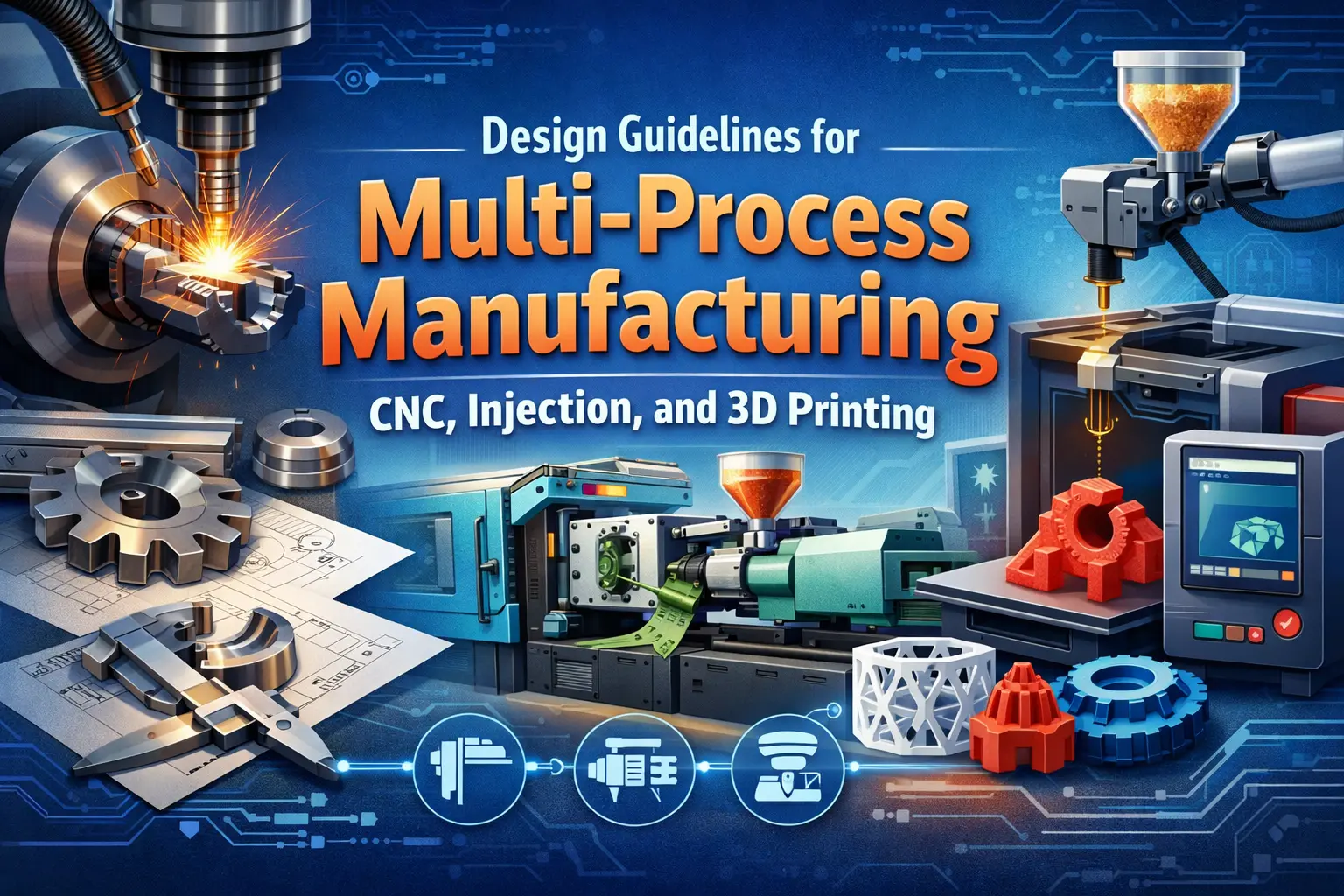
Multi-process manufacturing refers to the strategic use of multiple production technologies—such as CNC machining, injection molding, and 3D printing—within a single product development cycle. Instead of relying on one manufacturing method, companies today combine these processes to maximize efficiency, flexibility, and performance. Each process plays a different role, from rapid prototyping to high-precision validation and finally to mass production.
This approach allows engineers to leverage the strengths of each technology. For example, 3D printing enables quick concept validation, CNC machining provides tight tolerances and excellent material properties, and injection molding supports large-scale production with low per-unit costs. However, without proper planning, transitioning between these processes can introduce design inconsistencies and unexpected costs.
Designing for only one manufacturing process often leads to problems later when scaling production. A design optimized purely for 3D printing may not be suitable for injection molding due to issues like wall thickness or draft angles. Similarly, a CNC-optimized design might include features that are difficult or expensive to replicate in molded parts.
By considering multiple processes from the beginning, designers can avoid costly redesigns and reduce time-to-market. This proactive approach ensures that the product remains manufacturable and cost-efficient at every stage of development.
A well-planned multi-process design strategy offers several advantages. It accelerates product development by enabling rapid iterations, reduces overall manufacturing costs by minimizing redesign work, and improves scalability from prototype to full production. Companies that adopt this approach are better positioned to respond to market demands and maintain a competitive edge.
If you want to ensure your design is optimized for all major manufacturing processes from the start, it is highly recommended to consult with experienced engineers. You can get expert support here: https://weyoungcnc.com/contact/
CNC machining is a subtractive manufacturing process known for its precision and versatility. It is widely used for producing metal and high-performance plastic parts that require tight tolerances and smooth surface finishes. However, designing for CNC requires careful attention to geometry and tool accessibility.
Designers should avoid deep and narrow cavities, as these require long cutting tools that can lead to vibration and reduced accuracy. Internal sharp corners should also be minimized, since cutting tools naturally create rounded edges. Adding fillets not only improves manufacturability but also enhances part strength.
Another important consideration is the use of standard tool sizes. Designing holes and features that match common drill and end mill sizes can significantly reduce machining time and cost. Threads should also follow standard specifications to ensure compatibility and ease of production.
Injection molding is the preferred method for high-volume plastic production, but it comes with strict design requirements. One of the most critical factors is maintaining uniform wall thickness throughout the part. Variations in thickness can lead to defects such as warping, sink marks, and internal stresses.
Draft angles are essential in injection molding, as they allow the part to be easily ejected from the mold. Without proper draft, parts may stick to the mold, causing damage or requiring additional force to remove. Designers should also minimize undercuts whenever possible, as they complicate mold design and increase tooling costs.
Material behavior is another key consideration. Plastics shrink as they cool, and this shrinkage must be accounted for in the design to ensure dimensional accuracy. Proper gate placement and flow analysis can further improve part quality and consistency.
3D printing offers unmatched flexibility in design, making it ideal for prototyping and complex geometries. However, it also introduces unique constraints that must be considered during the design phase. One of the most important factors is build orientation, which affects both surface quality and mechanical strength.
Overhangs and unsupported features can lead to printing defects, so designers should minimize these or include support structures where necessary. However, supports increase post-processing time, so optimizing the design to reduce their use is highly beneficial.
Layer adhesion is another important aspect. Parts are typically weaker along the layer lines, so critical load-bearing features should be oriented to maximize strength. Additionally, surface finish may require post-processing depending on the application.
Understanding these process-specific requirements is essential for creating designs that can transition smoothly between different manufacturing methods. If you need help evaluating your design for CNC, injection molding, or 3D printing, you can reach out here: https://weyoungcnc.com/contact/
One of the most effective ways to ensure compatibility across CNC machining, injection molding, and 3D printing is to standardize design features as much as possible. Standardization reduces complexity, simplifies production transitions, and minimizes the need for redesign when switching between manufacturing methods. This is especially important for companies that plan to move from prototyping to mass production without delays.
For example, using standardized hole sizes, thread specifications, and fastening systems ensures that parts can be easily manufactured regardless of the process. CNC machining benefits from standard drill sizes, while injection molding requires consistent feature replication within molds. Similarly, 3D printing can handle a wide range of geometries, but maintaining standard dimensions improves consistency when transitioning to other methods.
Another important aspect is avoiding process-specific features that cannot be easily replicated. Complex internal geometries that work well in 3D printing may be impossible or too costly in CNC or injection molding. By simplifying designs and focusing on universally manufacturable features, engineers can create parts that adapt seamlessly across processes.
Standardization also improves communication between design and manufacturing teams. When everyone works with consistent design rules, it reduces misunderstandings and speeds up production. This ultimately leads to better product quality and faster time-to-market.
If you are unsure how to standardize your design for multiple manufacturing processes, consulting with experienced engineers can provide valuable insights. You can get professional support here: https://weyoungcnc.com/contact/
Tolerance management is one of the most challenging aspects of multi-process design. Each manufacturing method has its own tolerance capabilities, and failing to account for these differences can result in parts that do not fit or function correctly. Designing with overly tight tolerances can also significantly increase production costs without adding real value.
CNC machining typically offers the tightest tolerances, making it ideal for precision components. However, injection molding and 3D printing have more variability due to factors such as material shrinkage, thermal expansion, and layer-by-layer fabrication. Designers must understand these limitations and adjust their designs accordingly.
A practical approach is to define critical tolerances only where necessary. Functional features such as mating surfaces, alignment holes, and sealing areas should have tighter tolerances, while non-critical features can allow for greater variation. This balance ensures that the part performs as intended without unnecessarily increasing manufacturing complexity.
Another key strategy is tolerance stacking analysis, which evaluates how individual tolerances combine across an assembly. This is particularly important when parts produced by different processes need to fit together. By anticipating these variations early in the design phase, engineers can prevent assembly issues and reduce the need for costly adjustments later.
Working with a manufacturing partner during the design phase can help identify realistic tolerance ranges for each process. If you need assistance optimizing tolerances for your project, you can reach out here: https://weyoungcnc.com/contact/
Material selection plays a critical role in ensuring that a design performs consistently across multiple manufacturing processes. Different processes support different materials, and even when similar materials are available, their properties may vary depending on how they are processed.
For example, a plastic part produced through injection molding may have different mechanical properties compared to the same material used in 3D printing. Similarly, CNC-machined parts often use solid stock materials with uniform properties, while additive manufacturing may introduce anisotropy due to layer bonding. These differences must be carefully considered when selecting materials for a multi-process design.
One effective strategy is to choose materials that are available across multiple processes or have close equivalents. This allows for consistent testing and validation during the prototyping phase while ensuring a smooth transition to production. For instance, engineers may use 3D-printed prototypes to validate geometry and then switch to CNC machining or injection molding with materials that offer similar strength and durability.
Cost is another important factor. High-performance materials may offer superior properties but can significantly increase production costs. Designers must balance performance requirements with budget constraints to achieve an optimal solution.
Additionally, environmental factors such as temperature, humidity, and chemical exposure should be considered when selecting materials. These factors can affect part performance and longevity, especially in demanding applications.
If you need help selecting the right materials for your multi-process project, expert guidance can make a significant difference. Contact a professional team here: https://weyoungcnc.com/contact/
Post-processing is often an overlooked aspect of manufacturing, yet it can have a major impact on both cost and lead time. Each manufacturing process requires different types of finishing, such as machining, polishing, support removal, or surface treatment. Designing parts that minimize these requirements can significantly improve efficiency.
In CNC machining, excessive post-processing may involve additional operations such as deburring, polishing, or coating. By designing parts with smooth transitions, proper tool access, and minimal sharp edges, designers can reduce the need for these secondary processes.
For injection molding, post-processing is usually minimal, but poor design can lead to defects that require rework. Ensuring proper wall thickness, draft angles, and material flow can help produce parts that require little to no finishing.
3D printing often requires the most post-processing, especially when support structures are involved. Removing supports can be time-consuming and may affect surface quality. By optimizing part orientation and minimizing overhangs, designers can reduce the need for supports and simplify post-processing.
Another important consideration is surface finish requirements. Not all parts need a high-quality finish, and specifying unnecessary finishing processes can increase costs. Designers should clearly define where surface quality is critical and where it can be relaxed.
Reducing post-processing not only lowers costs but also shortens production timelines. If you want to optimize your design for minimal finishing and faster delivery, you can get expert advice here: https://weyoungcnc.com/contact/
One of the most effective ways to control manufacturing costs is by simplifying part geometry. Complex designs often require specialized tooling, longer machining times, and additional processing steps, all of which contribute to higher expenses. By focusing on essential features and eliminating unnecessary complexity, designers can significantly reduce production costs.
For CNC machining, intricate geometries may require multiple setups or custom tools, increasing both time and cost. Simplifying features such as deep pockets, sharp corners, and thin walls can improve efficiency and reduce machining time. In injection molding, complex designs can lead to expensive molds with additional components such as sliders or lifters. Simplifying the design reduces tooling costs and improves production reliability.
3D printing allows for complex geometries, but excessive complexity can still increase print time and material usage. Additionally, intricate designs may require more supports, leading to longer post-processing times. By optimizing geometry for function rather than aesthetics alone, designers can achieve a balance between performance and cost.
Ultimately, simplicity in design leads to efficiency in manufacturing. If you need help refining your design to reduce costs without compromising quality, you can consult experts here: https://weyoungcnc.com/contact/
Selecting the appropriate manufacturing process at each stage of product development is crucial for optimizing both cost and lead time. Each process has its own strengths, and using them strategically can significantly improve efficiency.
During the early stages, 3D printing is ideal for rapid prototyping due to its low setup cost and quick turnaround. It allows designers to test concepts, identify design flaws, and make adjustments without significant investment. Once the design is validated, CNC machining can be used to produce functional prototypes with higher precision and better material properties.
For large-scale production, injection molding becomes the most cost-effective solution despite its high initial tooling cost. The key is to transition to injection molding only when the design is finalized, as any changes to the mold can be expensive and time-consuming.
Understanding when to use each process helps avoid unnecessary expenses and delays. A well-planned strategy ensures that resources are used efficiently throughout the product lifecycle.
If you are unsure which process is best for your project at each stage, professional guidance can help you make the right decisions. You can get expert recommendations here: https://weyoungcnc.com/contact/
Lead time is a critical factor in product development, especially in competitive markets where speed can determine success. Design efficiency plays a major role in reducing lead time by simplifying production processes and minimizing delays.
Designs that are easy to manufacture require fewer setup steps, less tooling, and shorter production cycles. For example, using standard components and avoiding custom features can significantly reduce preparation time. In CNC machining, reducing the number of operations and setups can speed up production. In injection molding, optimizing mold design ensures faster cycle times and consistent output.
Another important factor is minimizing design revisions. Frequent changes during production can cause delays and increase costs. By validating designs early and considering manufacturing constraints from the beginning, designers can avoid unnecessary iterations.
Communication between design and manufacturing teams is also essential. Clear specifications and well-documented designs reduce the risk of errors and ensure a smoother production process.
If you want to accelerate your production timeline and improve efficiency, working with experienced professionals can provide valuable insights. Contact a team of experts here: https://weyoungcnc.com/contact/
Early design validation is one of the most effective ways to reduce both cost and lead time in multi-process manufacturing. Identifying potential issues before production begins allows designers to make adjustments without incurring significant expenses.
Simulation tools, prototyping, and testing are all valuable methods for validating designs. However, one of the most reliable approaches is collaborating with experienced manufacturing experts who understand the nuances of different processes. Their insights can help identify potential challenges and suggest practical solutions.
Collaboration also improves decision-making. Designers can receive feedback on material selection, tolerance requirements, and process compatibility, ensuring that the final design is optimized for production. This proactive approach reduces the risk of delays, rework, and unexpected costs.
In today’s fast-paced manufacturing environment, working in isolation is no longer effective. Successful projects rely on strong collaboration between design and production teams.
If you want to ensure your design is fully optimized before production begins, it is highly recommended to seek expert support. You can start here: https://weyoungcnc.com/contact/
Designing for multi-process manufacturing—combining CNC machining, injection molding, and 3D printing—requires careful planning, material selection, and feature standardization. By understanding the strengths and limitations of each manufacturing method, engineers can create designs that are not only functional but also cost-effective and scalable. Early collaboration with manufacturing experts ensures that parts are optimized for tolerances, material behavior, and process transitions, reducing costly redesigns and accelerating time-to-market.
A well-executed multi-process design strategy enables seamless transitions from prototyping to production while maintaining quality and performance. Standardizing features, managing tolerances, minimizing post-processing, and choosing appropriate materials are critical steps to achieving efficiency. In addition, simplified geometries and strategic process selection help reduce both cost and lead time, allowing companies to remain competitive in fast-paced industries.
Optimizing your product design for multiple manufacturing processes can be challenging, but professional guidance can make the process smoother and more cost-efficient. For tailored advice and support on CNC, injection molding, and 3D printing designs, reach out to the experts at WeYoung CNC today: https://weyoungcnc.com/contact/
